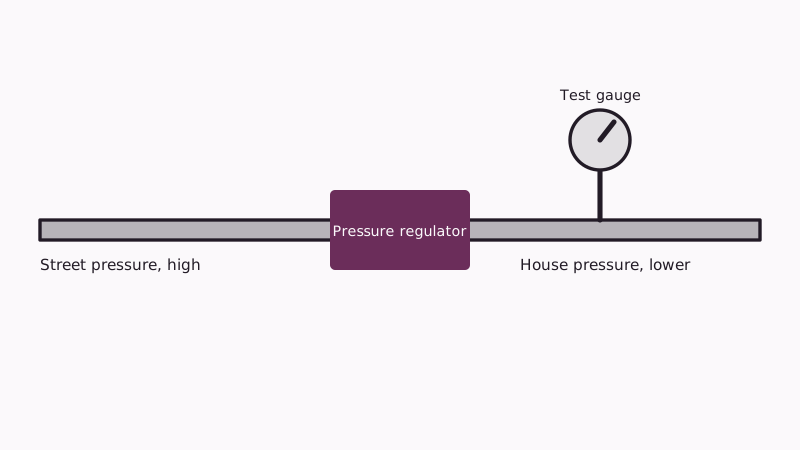
Street pressure is set for the benefit of the whole neighborhood, and it can be more than one household's plumbing is happy to take. The pressure regulator, a small brass bell fitted at the point of entry, trims that figure to something calmer. Weak flow is the opposite complaint and gets a page of its own; here the subject is the valve.
Which job does a pressure-reducing valve do for a house?
Its single task is to cap what the house sees, whatever the main delivers. Wikipedia sums up regulators as valves that hold a fluid at a chosen pressure. Indoors that shields faucets, hoses, supply lines and appliances from overpressure, which is the cheapest protection a plumbing system gets.
Unprotected pipes feel every surge, and the symptoms are familiar: hammering in the walls, a dripping relief valve, bulging washer hoses, faucets that need washers again and again. Installers usually set the bell well beneath the code ceiling, and a screw on top allows later adjustment.
When does the code say a home must have one?
Plumbing code section 608.2 in California sets eighty pounds per square inch as the limit on static pressure in supply piping. Beyond it, a regulator of an approved type, fronted by a strainer, has to bring the figure back down. Padre Dam's page repeats the ceiling and adds a floor of 15 psi at fixtures.
Regulators have to meet recognized product standards, and each one needs an expansion tank of approved type on the cold supply after it. A secondary reading of the rule says it targets new construction, which leaves an older house above the limit as something for a plumber to judge. Padre Dam quotes a usual indoor range of 45 to 65 psi, a handy target.
How do I find mine?
Check close to where the water main reaches the house: a garage wall, a spot near the main shutoff, often on the same pipe that feeds an outside spigot. Padre Dam describes a small dome with a screw on top. Plenty of owners never notice it until it fails.
Nothing there? Some sit in a box beside the meter, or hide in a crawl space under the floor. Hillside lots such as those in Anaheim Hills often tuck the valve into a side-yard box where access is cramped. A plumber locates it by tracing the line from the meter and reading the dial of a test gauge.
What shows that pressure is excessive or the valve is spent?
Hammering pipes, a relief valve weeping at the water heater, toilets that refill after the tank is full, swollen supply hoses and short-lived faucet parts are the usual clues. A screw-on test gauge reads the truth, and anything above eighty is over the limit.
The valve can also fail in the other direction: Padre Dam names a faulty or misadjusted regulator among causes of weak flow. Scale matters in Anaheim, where the city reports roughly 18 grains of hardness per gallon, because deposits foul the seat inside the bell. Readings that wander, or climb overnight while nothing runs, suggest a failing seat; installers call that creep. After testing upstream and downstream, a plumber decides between adjusting and replacing, as laid out in setting the valve.
Which companions travel with the regulator?
The code lists a strainer ahead of the valve and an expansion tank behind it. A test gauge on an outdoor spigot is the easiest monitor, and many installs include shutoffs on both sides so the bell can be serviced. The tank absorbs the extra volume that heated water creates.
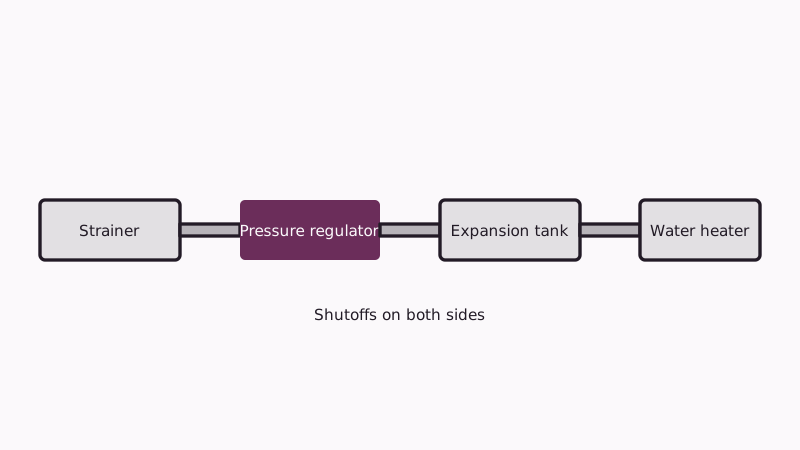
The reasoning: with a regulator in place the water system becomes closed, so water that swells in the heater has nowhere to go and pressure spikes, which can make the heater's relief valve drip. A regulator without a tank is a classic cause of that drip. Read about swapping an expansion tank if yours is waterlogged.
Is replacing one a weekend project, and what does it run?
It is work on the main supply, plenty of owners hand it off. Cost hinges on pipe size, access and whether a strainer, tank or shutoffs get added; the numbers we checked are laid out on the regulator cost page. Insist on a written estimate before work begins.
State licensing starts at $1,000 for labor and materials, a mark a plain swap may not reach, yet one mistake on the main floods a house fast. Close the supply at the meter or house valve first. To book help, start with the quote page.
Do hillsides and homeowner associations change the picture?
Yes, in two ways. An HOA with shared plumbing may own the main and the regulator, so confirm who is responsible before paying. And elevation matters: Padre Dam notes altitude and distance from the reservoir shift pressure, so a hillside lot can run higher or lower than flat streets.
Faults between the meter and the house are generally the owner's concern; anything upstream is the supplier's. Ask the water provider, whether Anaheim, Fullerton, Orange or another, what normal pressure is on your street. Related reading: low pressure causes.
Common questions
What pressure should the valve be dialed to?
Eighty psi is the code ceiling, while Padre Dam calls 45 to 65 psi the normal indoor range. Many installers pick a figure inside that band, though the ideal one varies with the home's fixtures. Ask the plumber what the valve was set to, and why.
Does an expansion tank have to go with it?
The code puts an expansion tank, approved type, on the cold supply after each regulator, or permits professionally designed alternatives using approved relief valves. If the water heater's relief valve starts to drip after a regulator goes in, a missing or failed tank is the prime suspect.
What is a regulator's working life?
The sources checked here give no fixed lifespan. Valves age with use and hard water, so read pressure with a gauge from time to time and replace the unit when numbers climb, sag or swing. Swapping early costs less than the damage a failure can cause.
Is a regulator the same thing as a booster pump?
They solve opposite problems. A regulator lowers excess pressure; a booster pump raises pressure that is too low, which matters where elevation prevents acceptable flow, as Padre Dam points out. A plumber can tell which of the two your house actually needs.
For the wider picture, start with Citrus Belt Plumbing plumber.
Sources
Last updated