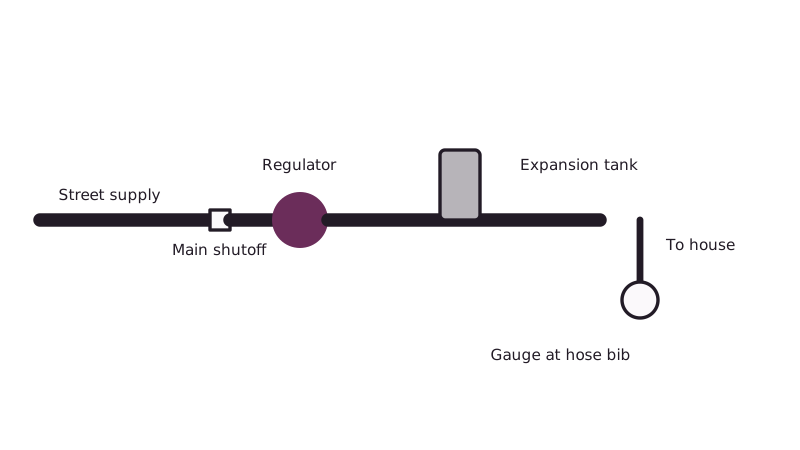
The bell-shaped brass valve near your main shutoff has one job, which is holding street pressure down to a level your pipes and appliances tolerate. After years of service its diaphragm hardens, its spring weakens or its screen clogs. Then pressure creeps up or falls away. This page is about the swap itself. Not sure the regulator is the culprit yet? Begin with the overview of hiring a plumber for weak flow.
Which symptoms point at a worn-out regulator?
Look at it when pressure swings for no reason, fixtures drip, pipes bang or whistle, or the heater's relief valve weeps. The check is cheap: a gauge on any outdoor spigot. Anything above 80 psi says the valve has failed or is set too high, while a very low reading with a clean strainer can mean it has stuck.
Signs, in the order people usually notice them:
- Faucets and toilet fill valves start leaking or running on, since excess pressure forces water past seats.
- Pipes hammer when a valve closes.
- The water heater relief valve drips, which can also mean thermal expansion with no expansion tank.
- Flow changes between morning and evening as street pressure shifts and the regulator no longer holds it steady.
- A weak trickle everywhere, when the internal screen is blocked or the valve has seized partly shut.
Published guides suggest regulators last roughly 7 to 15 years. Hard water can shorten that. The city's utility reports roughly 18 grains per gallon, and scale may choke the screen and the seat.
What does the plumbing code say about regulators?
Under section 608.2 of the plumbing code, California wants an approved regulator and a strainer ahead of it wherever supply pressure could pass 80 psi, adjusted to hold the house at 80 or lower. The valve must meet ASSE 1003 or AWWA C530, and sizes from 1 1/2 inches up skip the strainer. An expansion tank is expected on the cold line past the regulator.
Why an expansion tank: with a regulator in place, the supply becomes a closed system. When the water heater warms, the water expands and has nowhere to go, so pressure spikes. The tank absorbs it. A new regulator on a house without a tank is a common reason relief valves start leaking afterward. The code allows relief valves set at 100 psi or less instead of tanks only in systems designed by a qualified professional.
Permits: whether the city wants one for a straight regulator swap varies, so check with your city's Building Division before work begins. Anaheim, Fullerton, Orange, Brea and Yorba Linda each run their own.
How is a regulator replaced, step by step?
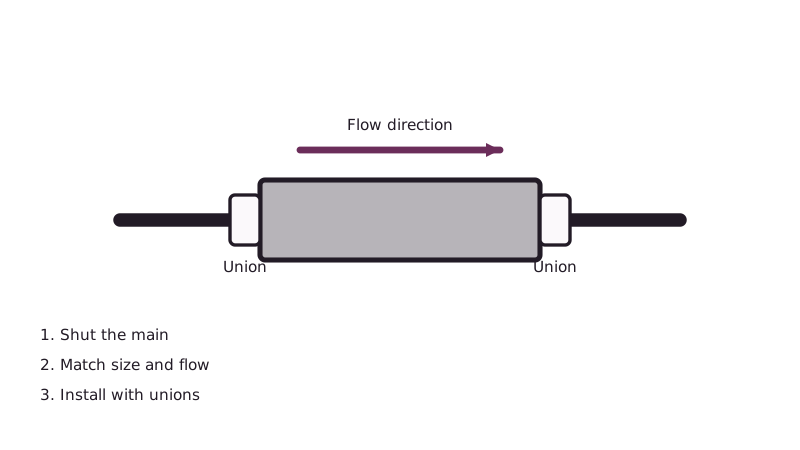
The sequence: shut the main, open a faucet to bleed off pressure, unscrew or cut out the old valve, and fit a new one matching the old size and flow direction, adding a strainer if the model lacks one. After a slow refill the plumber dials in pressure while watching a gauge, then inspects every joint for drips. Expect one to three hours.
A bit more detail:
- Measure first. Read the gauge on a hose bib so there is a before number.
- Shut the main, then crack a faucet to let the line drain down.
- Remove the old regulator. Threaded unions come apart with wrenches; sweat-soldered valves are cut out.
- Match the replacement to the pipe size and to the flow arrows on its body.
- Install and tighten, adding unions if the old setup had none, so the next swap is easier.
- Add an expansion tank if there is a water heater and none is present.
- Open slowly, purge air, set the screw and recheck pressure at the spigot.
A screw on top sets the output; how that works is covered in adjusting a pressure regulator valve.
Is this a weekend project for an owner?
For a skilled owner, perhaps; it is a short run of pipe, a few fittings and a gauge. The challenge is access: a stuck main shutoff, corroded unions or a valve in a buried meter box. If the main shutoff will not close fully, stop and call a plumber. Solder joints near the main, an expansion tank and any permit are good reasons to hire the job out.
Mistakes that cost more than a visit: using a valve too small for the line, setting the pressure above 80 psi, forgetting the expansion tank, or over-tightening a union until it cracks. If the regulator sits in a front-yard box near the meter, it may belong to the water utility's side of the system, so confirm before you touch anything. Wondering where the valve hides? See finding the regulator on your property.
What does a regulator replacement cost in Anaheim?
Plumber-installed replacements run about $200-$700 in published guides, most between $300 and $600. The valve itself is $50-$200 and labor is typically $225-$450. Add a new main shutoff and the job reaches $450-$800. Merely adjusting a working valve is cheaper at $100-$200, and a do-it-yourself swap costs roughly $65-$180 in parts.
| Item | Guide range |
|---|---|
| Valve alone | $50-$200 |
| Labor, one to three hours | $225-$450 |
| Replacement, installed | $200-$700, most $300-$600 |
| Replacement plus new main shutoff | $450-$800 |
| Adjustment only | $100-$200 |
| Repair of a failing valve | $75-$200 |
Those are guide numbers and the plumber's written quote decides your price. Tight crawl spaces and buried meter boxes add labor, and complex relocations can top $1,000. The regulator installation cost guide itemizes a quote, and whole-house regulators covers larger homes.
Common questions
Why does pressure climb when a regulator fails?
Inside, a spring and diaphragm throttle the flow. A torn diaphragm or a worn seat lets full street pressure through, so a house that sat comfortably below the limit can drift past 80 psi, which is hard on fixtures, hoses and the water heater.
What is the time commitment?
Guides mention one to three hours when access is good, with water off the whole time. A seized shutoff, corroded unions, an added expansion tank or a valve down in a meter box can stretch the visit, so stock some water in pots beforehand and avoid laundry day.
Must someone be present?
Yes, for part of it: letting the plumber in, showing the main shutoff and the old valve, and reading the new gauge result afterward. In many houses the work happens in a garage or outdoors, so the middle of the visit is yours.
What belongs in the written estimate?
The valve brand and size, confirmation it meets ASSE 1003, whether a strainer and expansion tank are included, the pressure it will be set to and who handles any permit. Add a question about a main shutoff that will not close, since that can put a second valve on the quote.
The rest of our guides start from plumber anaheim.
Sources
- California Plumbing Code section 608.2, excessive water pressure
- City of Anaheim, water hardness (about 18 grains per gallon)
- Published pressure-reducing valve replacement price guides, checked November 2026
Last updated