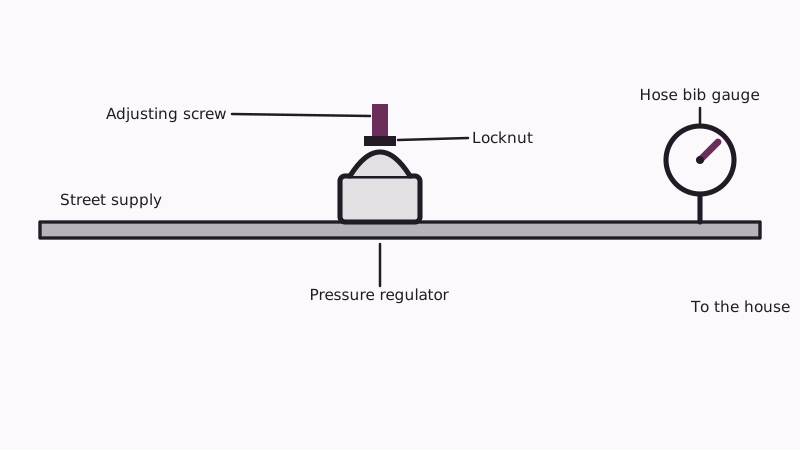
This guide from Citrus Belt Plumbing covers one job. Adjusting a home regulator starts with a gauge threaded onto an exterior hose bib and a reading with all water off, followed by a slackened locknut and small turns of the adjusting screw. On the common bell-style valve, turning clockwise adds pressure and turning back subtracts it. For weak pressure throughout the house, the low water pressure plumber page covers every cause, not just this valve.
What is a home water pressure regulator, and how does it work?
The regulator is a dome-shaped valve fitted in the main supply line, typically just inside where the pipe reaches the building. A spring and diaphragm inside tame the high pressure in the city main into a steadier level for your fixtures, and the adjusting screw alters the spring tension that sets the outlet psi.
Look beside the main shutoff or the heater, in the garage, a basement, or a utility box on the street side. A house without one may be taking full street pressure into its pipes and appliances.
What psi should my water pressure be set at?
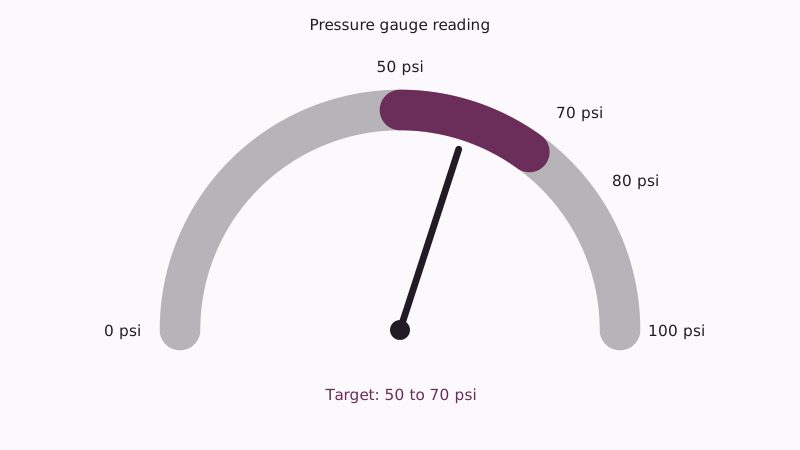
Most installers target 50 to 70 psi, a range that gives good showers without straining pipes, hoses and appliances. California Plumbing Code 608.2 requires a regulator that keeps static pressure at or under 80 psi where the supply runs higher.
The "pressure tank" psi in the question is a different thing. Tanks on private wells are set to cut-in and cut-out values, often 40/60 or 30/50, and they are not the regulator. A home on city water in Anaheim, Fullerton or Orange has no such tank, so the regulator is your adjustment point.
Hillsides matter. Houses lower on a slope see higher static pressure than houses above them, which is one reason hillside neighborhoods such as Anaheim Hills and Yorba Linda can read differently from nearby flat streets. See our Anaheim Hills plumber page.
How do I read my pressure before touching the screw?
A hose-bib pressure gauge costs little at a hardware store. Fit it to an outside spigot, open that spigot all the way, and keep every other fixture off. The needle shows static pressure. Read it again after each change. Above 80 psi is too high; below 40 is usually too low.
Test early or late in the day, when neighbors use little water, since street pressure shifts through the day. Note the number on your phone. A needle that creeps up over a few minutes with everything off suggests the regulator is failing and passing full main pressure.
How do I adjust the regulator, step by step?
Read the gauge, loosen the locknut above the regulator body, then turn the screw or bolt in half-turn steps. Open a tap briefly to let the reading settle, then look at the gauge again. When you reach your target, tighten the locknut and recheck. Valve designs differ, so consult the manual.
- Close any water-using appliance and read the starting psi on the gauge.
- Loosen the locknut with a wrench, holding the screw still.
- Rotate clockwise to raise pressure or anticlockwise to lower it, half a turn per move.
- Run a tap briefly, shut it, and take another gauge reading.
- Repeat until you reach a figure in the 50 to 70 psi range, or the one a plumber advised, then tighten the locknut.
Never turn the screw far in one go. Pressure rises fast, and a spike can stress a washing machine hose or a toilet valve.
Why doesn't the pressure change when I turn the screw?
The regulator has probably failed. Diaphragms wear out and mineral deposits can clog the seat or strainer. Anaheim water is rated by the City at about 18 grains per gallon, which is very hard, and scale often makes an aging regulator stick. If the screw changes nothing, replacement is the answer.
Other signs of failure are banging pipes, a rising gauge reading after your adjustment, a hissing sound at the unit, or a dripping toilet valve. Water pressure problems in Orange County homes can trace back to a worn regulator, so check how old yours is before you spend an afternoon adjusting. Prices are on our what a regulator costs to install page.
Can a homeowner swap out a regulator?
Sometimes, though the job opens up the main supply line. It calls for soldering or compression-fitting skill, a shutoff valve that actually works, and a check on whether the city requires a permit. If any of that is uncertain, hiring a plumber is the cautious option.
Plenty of houses also need an expansion tank after a regulator goes in, since the regulator closes the system and heat expansion has nowhere to go; the code places it downstream of the regulator. Raise it with the plumber. In an HOA or townhome, find out who owns the main line before touching anything, because the association may handle it. The quote form starts a local visit.
Common questions
How do I replace a pressure regulator?
Close the main, empty the line through a tap, remove the old regulator and fit the replacement with the flow arrow pointing the same direction,. Add a strainer if none exists. Reopen water slowly and set the psi with a gauge. Anything involving a torch is for a plumber.
How does a regulator differ from a shower head pressure regulator?
A shower head flow restrictor limits water at one outlet, while the whole-house regulator controls pressure for every fixture. Adjusting a shower head will not help with banging pipes or high pressure elsewhere. For low flow at one shower, see shower water pressure is low.
Can I install a water pressure regulator myself?
That turns on your skill and local rules. The work touches the main line and frequently needs soldering, and an error can flood the house. Replacing like with like is more manageable than a fresh install. Where a permit is required, California restricts the job to a contractor holding a license.
Do I need an HOA's permission?
If the regulator sits on a shared line, or the HOA controls the plumbing and landscaping, ask the HOA first. Many townhome and condo associations manage the main supply. Your own regulator inside your unit is usually yours to deal with, but check your governing documents or ask the management company.
What happens if I set the pressure too high?
Pressure above 80 psi stresses supply lines, water heaters, faucets and toilet valves, and it can cause leaks and early failures. It also raises the chance of banging pipes. If your gauge shows more than 80 psi after adjusting, turn the screw back and consider having a plumber check the regulator.
Sources
Last updated