For most houses in Anaheim, Fullerton and Orange, PEX is the cheaper and faster material to put in, and copper is the traditional one with a long record. Neither is wrong. If you are comparing them because a whole-house repipe is on the table, the useful questions are how much each costs, how the water here treats each, and what your walls allow. This page takes those in turn, and the quote page lets you request a price for each.
Which costs less, PEX or copper?
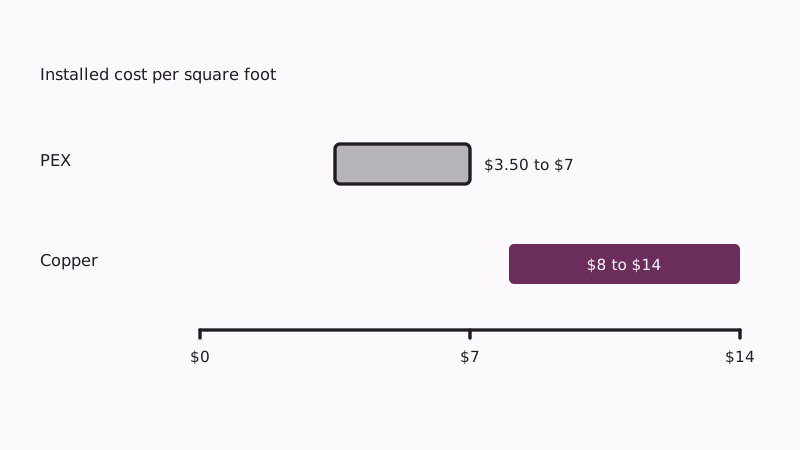
On a whole-house job PEX wins on price, comfortably. Published cost guides put a whole-house PEX repipe near $4,000 to $10,000 and copper near $8,000 to $18,000. Those are guide figures only, and the written quote sets the price for your house.
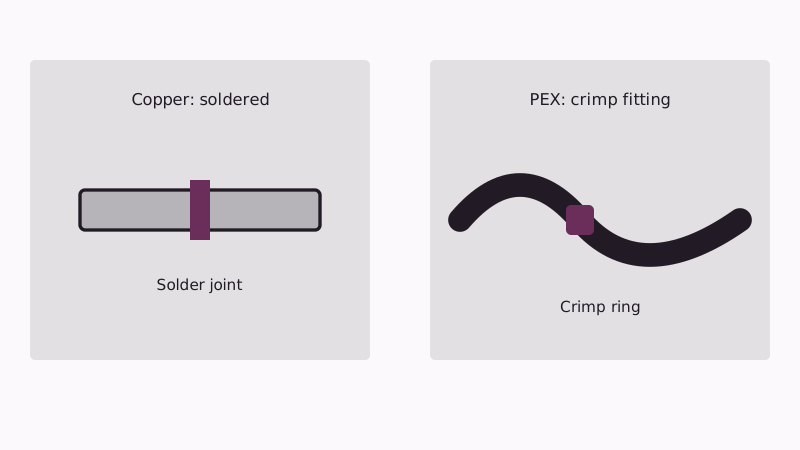
Where the gap comes from is mostly labor. Copper has to be cut, fitted and soldered with a torch joint by joint, while PEX is a coil that bends around corners and snaps into fittings. Copper also carries a bigger material bill, and its price follows the metal market, so quotes for it can move from month to month.
Those figures come from cost-guide sites, not from any Anaheim price list, so use them only to compare the two. Our repipe cost guide and what a PEX repipe runs show what moves the number for a given house.
Is PEX even allowed in California?
Yes. California's building standards commission adopted PEX for water supply in the plumbing code after an environmental review, with the rules taking effect in 2009. Current code treats it as a normal choice for hot and cold supply in houses. Underground use has its own conditions, so ask how any buried run will be protected and what the inspector expects.
A city can add its own rules, and some older tracts have homeowner association requirements. For that reason a repipe is permitted through the city Building Division no matter which pipe goes in, with the paperwork and inspection booking handled by whoever does the work.
How do they compare on flow and pressure?
Slightly in copper's favor on paper, rarely noticeable in a house. For the same nominal size, PEX tubing has a thinner bore than rigid copper, and the fittings narrow it further. A copper run and a PEX run of the same size will not deliver identical flow.
Installers handle this in the design. A PEX layout can use a manifold with a separate line to each fixture, or larger pipe on the main run. Pressure at the tap depends far more on the street supply and on the regulator at your house than on the tube. If low flow is the reason you are repiping, read why pressure falls in older homes first, because scale in an old galvanized line is the usual cause, not the pipe size you would choose next.
Which one lasts longer in Southern California water?
Copper has the longer history, and manufacturers of both quote service lives measured in decades. What decides the outcome here is water chemistry. Anaheim's utility lists its water at about 18 grains per gallon, which is very hard, and hardness builds scale in hot lines. Copper can also develop pinhole leaks when the water is aggressive, a pattern plumbers in Southern California report in some neighborhoods after 20 to 30 years.
PEX does not corrode, so it never gets a pinhole from water chemistry. Brass fittings in a PEX system are a separate matter and can still wear. Hard water scales fittings and fixtures in either system, so a softener or scale control matters regardless of pipe. See pinhole leaks in copper if that is already your problem.
Honest answer on lifespan: neither has a number that holds for every house. Ask the plumber what the plan is for your specific supply, and the grade question is covered in PEX A against PEX B.
Does cold weather matter for PEX or copper here?
Not much on the valley floor. Anaheim winters are mild, and frozen lines are rare. Where it does matter, PEX has an edge, since the tubing can stretch when water inside it freezes, while rigid copper is more likely to split. Pipes in an unheated attic, a garage wall or an exposed hillside run in Anaheim Hills are the ones to insulate.
Direct sun is the opposite problem. PEX degrades in sunlight, so it must be kept covered and cannot run exposed outdoors. Copper tolerates UV but can corrode in contact with some soils, which is another reason slab and underground lines get a closer look.
What about CPVC and PVC?
PVC is standard for drains and vents. It is not made for hot drinking-water supply. CPVC, a heat-rated cousin, is used for supply lines and often seen in tract homes from certain decades. It can turn brittle with age, so a CPVC house often becomes a repipe candidate when joints crack.
When the options are PEX, copper and CPVC for a repipe, most contractors in the area lean to PEX for cost and speed, with copper going to owners who prefer metal or need to match what is already in the walls. You can ask for both on the same quote and compare line by line.
Is it worth tearing out copper that still works?
Usually not. Sound copper with no leaks does not need replacing for its own sake. The questions that make a repipe worth the money are different: repeated pinhole leaks, rusty or low-flow galvanized lines, polybutylene that is known to fail, or a house where walls are already open. For the older materials, see polybutylene replacement.
A repipe also makes sense with a remodel, since the walls are open anyway and the labor shrinks. Our page on how a repipe is done walks through the sequence from shutoff to patched drywall.
Common questions
What fittings join PEX, and what are crimp rings?
PEX connects with metal or plastic fittings. Crimp rings are copper or stainless bands squeezed onto a barbed fitting with a tool, and cinch clamps are the same idea with a different tool. PEX-A can also use expansion rings, where the pipe is stretched and shrinks back around the fitting. Push-fit connectors exist as well, and are often used for repairs.
Does PEX affect the taste or safety of the water?
PEX that carries a drinking-water listing is approved by the California code for drinking water, and so is copper. Some people notice a plastic taste in a new PEX system that fades after flushing. If it persists, tell the plumber, because a bad batch or a poor connection is easier to correct early than after the walls are closed.
Can I mix PEX and copper in one house?
Yes. Plumbers join them all the time with transition fittings, for example when repairing one section of an older copper system. The usual caution is dissimilar metals, so brass and approved fittings are used where plastic meets metal. A full repipe is easier to price when the whole system is one material.
How many days is the house without a full water supply?
Cost guides suggest three to five working days for PEX and five to seven for copper in a mid-size house, longer for two stories or a slab. Expect the taps to be dry for parts of each working day only. Drywall patching and paint come after, usually as their own line on the quote.
Does a house need a permit to switch pipe type?
In Anaheim a whole-house repipe goes through the city's plumbing permit process, while Fullerton, Orange and the rest each have a Building Division of their own. Ask at the quote stage who pulls the permit and arranges the walkthrough with the inspector. Treat that visit as mandatory.
More services are listed on plumber in Anaheim.
Sources
- California approves PEX for state plumbing code, Contractor magazine
- PEX Officially Adopted into California Plumbing Code, Pro Tool Reviews
- City of Anaheim, water hardness (about 18 grains per gallon)
- Published whole-house repipe price guides, checked November 2026
Last updated