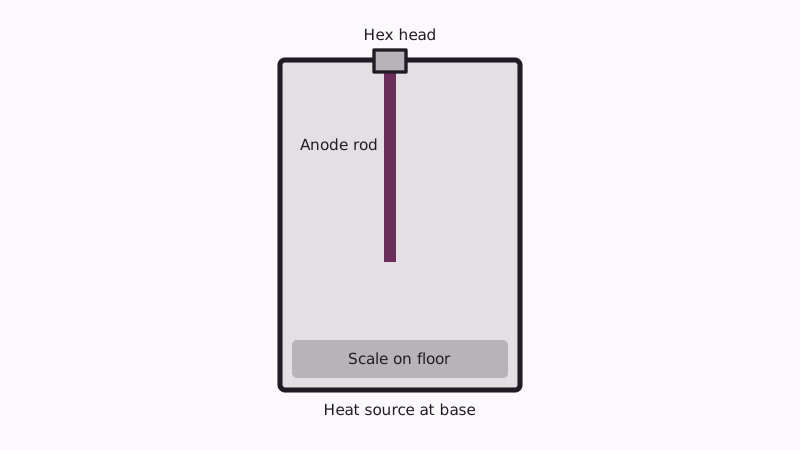
Replace the anode rod when it is mostly eaten away, which for many tanks means checking after about three years and then every year. Catch it in time and a tank can last years longer. Wait until the tank wall is corroding and no rod will save it. Part of the water heater section, this guide covers the check, the swap and the point where handing it off is wiser.
What is the anode rod doing in there?
A rod of magnesium or aluminum, hung inside the tank, that rusts away so the steel does not. Glass-lined tanks always have tiny gaps in the lining, and the rod offers corrosion an easier target. When it is spent, the tank wall becomes the target and eventually leaks. Hence the name sacrificial anode.
Material hosted by DOE says that every storage heater has at least one rod, that it wears down slowly, and that poor water quality, hot settings, heavy use and softened water all hurry it along. Tanks lined with plastic, stainless steel or stone skip the rod. A tankless unit has no tank, so it has none either. Choosing between them? The tank versus tankless page compares them.
How often does the rod need replacing?
Look at it about three years after installation, then yearly, which is the schedule in manufacturer guidance hosted by DOE. Swap it once it is pitted, thin or down to a bare steel core. Softened water calls for a yearly look. You will see a four to five year rule of thumb online, but the rod's condition is the real test.
Local water matters. Supplies in this part of Orange County are often hard, and hard water lays scale across the tank floor while the rod works overtime. A softener means a yearly inspection. Your water supplier's annual quality report gives hardness, and hard water scale prevention covers the scale side.
Can I check or replace the anode rod myself?
A handy homeowner can often manage it on an electric or gas tank, but the job has real risks, and gas piping is strictly for a contractor. It means switching off power or gas, closing the cold supply, draining some water and unscrewing a rod that may have seized after years in hot water.
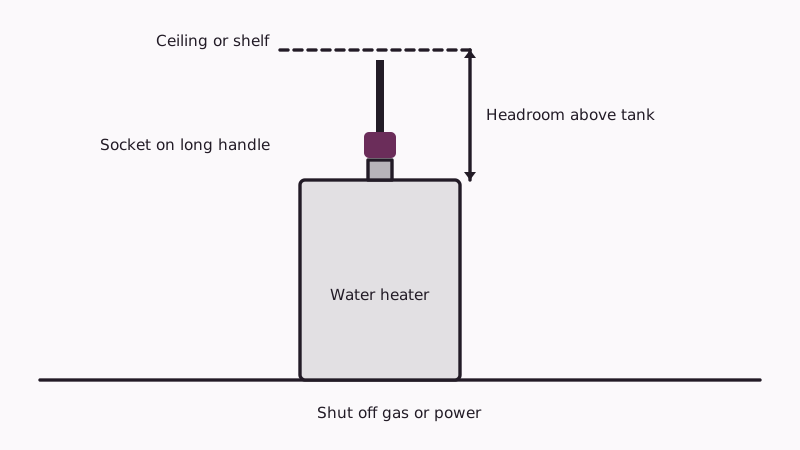
Rough sequence for a sound tank:
- Turn the thermostat to pilot or vacation on gas, or switch the breaker off on electric. Close the cold inlet valve.
- Turn on a hot faucet indoors, run a hose from the drain valve to a floor drain or the yard, and release enough water that the level falls under the top of the tank.
- Find the rod. It is usually a hex head on top of the tank, sometimes under the hot outlet nipple. Some sit under a plastic cap.
- Break it loose with a socket on a long handle. A seized rod can take real force, and the tank has to stay steady. Stop if it will not turn.
- Lift the rod out and inspect it. If it is thin or pitted, fit a new one with thread tape on the threads.
- Refill with that hot tap still open until water flows steadily, then restore power or gas and look for drips.
Overhead clearance matters. Many closets and garage corners have little headroom above the tank, and a flexible rod is made for that. If the tank is a gas unit, do not touch the gas line, vent or relief valve.
When should a plumber handle an anode rod replacement?
A plumber should take over if the rod will not budge, the tank already leaks or rusts at the base, the top is out of reach, or anything touches gas, venting or the relief valve. The plumber can also judge the rest of the tank. On an old tank, a new rod is often wasted money.
Swapping out the whole heater takes a permit in Anaheim and nearby cities. A rod swap alone is maintenance, but confirm with your city's building division if connections change. Past roughly ten to fifteen years, which is the typical storage tank life in DOE figures, a new heater usually beats a new rod. See the usual replacement interval and the price of a new water heater.
What will the swap cost?
The rod is a modest purchase at a hardware or plumbing supply store, and the bigger cost is labor if a plumber does it. Price turns on access, on whether the rod is seized, and on whether a flush is bundled in. Ask for a written quote. Ranges are in what an anode rod replacement costs.
Rods are not all alike. Magnesium is commonly paired with soft water and aluminum with hard water. A rotten-egg smell can come from bacteria feeding on the rod's reaction, and a plumber may suggest another type or a flush. Powered rods are a separate, pricier product.
What happens if I never replace it?
A spent rod stops protecting the tank, and corrosion moves onto the steel. First rusty hot water, then a leak, then a dead unit that costs many times what a rod does. Keeping the rod fresh is among the cheapest water heater repair jobs there is.
Signs the rod is gone: rust-tinted hot water with clean cold, a metallic taste, popping from sediment, dampness at the base. A leaking tank cannot be saved by a rod. When the leak has already started, read water heater repair emergency.
Common questions
Will I lose hot water for long?
On a straightforward tank the work itself is short, but you lose hot water while it drains, refills and reheats, so expect a part of the day. A seized rod stretches that a lot. Headroom above the tank is the usual surprise, so ask the plumber what the estimate assumes.
Is it worth replacing the rod on an old tank?
Often not. If the tank has outlived 10 to 15 years, shows rust at the seams or has been weeping at the base, a new rod will not stop a failure already under way. Have the tank inspected before you spend on a rod, and get any price in writing.
What helps the plumber before arriving?
Note the heater's age, its fuel, any softener on the supply, and anything you have noticed such as rust, drips or noise. Then make sure the heater and its shutoffs are easy to reach, so the plumber can start work without moving boxes or shelving.
Is there an anode rod in a tankless unit?
No, since a tankless water heater holds no stored water and has no tank wall to protect. Its enemy is scale on the heat exchanger. DOE material says flushing as the maker directs keeps scale in check, which matters even more with hard water.
Want a plumber to check the heater? Send a note through the quote page, or begin at the Citrus Belt Plumbing home page.
Sources
- U.S. Department of Energy, Measure Guideline: Transitioning to a Tankless Water Heater
- U.S. Department of Energy rulemaking documents and manufacturer guidance on anode rods in glass-lined tanks (summarized from DOE-hosted material, checked November 2026)
Last updated