A repipe quote cannot be worked out from floor area alone, yet the published ranges are good enough to tell whether an offer is sane. In a house somewhere between 1,500 and 2,000 square feet, PEX tends to land from the mid four figures up to about $12,000, and copper starts near $7,000 and can pass $20,000, patching extra. Below you will find a worksheet built from those ranges. For the work itself, read repiping and pipe replacement, and price your own house through the quote page.
How is a repipe priced by the square foot?
Cost guides quote PEX at around $3.50 to $7 a square foot and copper at $8 to $14. Multiply by the floor area to get a starting figure, then nudge it for stories, bathrooms and wall access. Treat the result as a comparison tool, since pipe length depends on layout and fixture count, not floor area.
A table to scribble on:
| Floor area | PEX | Copper |
|---|---|---|
| 1,000 sq ft, one bath | $3,500 to $7,000 | $8,000 to $14,000 |
| 1,500 sq ft, two baths | $4,500 to $8,500 | $7,000 to $12,000 |
| 2,000 sq ft, two or three baths | $6,000 to $12,000 | $10,000 to $20,000 |
The top row is plain arithmetic on the per-foot guide. Sources disagree at the edges, and copper moves with the metal market, so a quote that differs from a cell here is not automatically wrong.
Does house size change the total much?
It does, though layout matters as much. Guides put a 1,500 square foot home near $4,500 to $8,500 with PEX or $7,000 to $12,000 with copper. Step up to 2,000 square feet and you are looking at $6,000 through $12,000, or $10,000 through $20,000. Two-story and slab houses push toward the high end.
Footage only stands in for pipe length. One long ranch house with a bathroom at each end can need more tubing than a compact two-story with stacked baths. Older single-story houses in Anaheim, Fullerton and Orange often sprawl, while the postwar tracts in Buena Park, La Habra and Placentia repeat one footprint, so neighbors on the same street often receive close numbers.
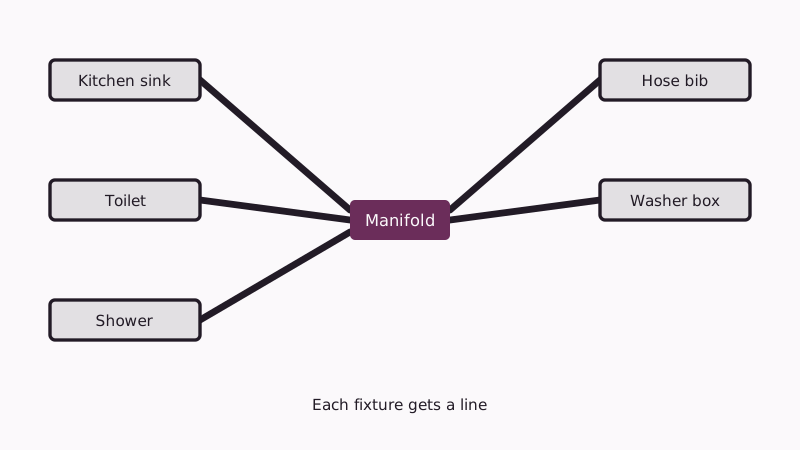
Count fixtures instead. Every sink, toilet, shower, hose bib, ice maker and washer box wants its own branch line.
How can a repipe come in cheaper?
Pick PEX, leave the fixture layout alone, and do everything in a single stretch of work. Material and labor savings are the big ones, but opening walls only once matters nearly as much. Two or three itemized proposals for identical scope keep the pricing honest, and a repipe booked alongside a remodel borrows the demolition someone else is paying for.
Replacing only the failed branch is the budget alternative. If most of the system is sound, a limited job may cost a fraction of the whole-house figure. If the walls hold aging galvanized or tired copper, though, the next leak is usually not far behind, and the saving evaporates. Pipes beneath the floor are their own question, handled in slab leak repair or repiping.
An offer far under the others deserves a second look, because the missing item is often the permit, the drywall patch or the fixture hookups.
Do the walls have to come out?
Largely not. A plumber cuts modest openings at studs, feeds flexible PEX through the cavities and patches afterward. Copper cannot bend that way, which is why PEX is the usual pick for finished houses. Attics, crawl spaces and garages let some runs avoid the living areas altogether.
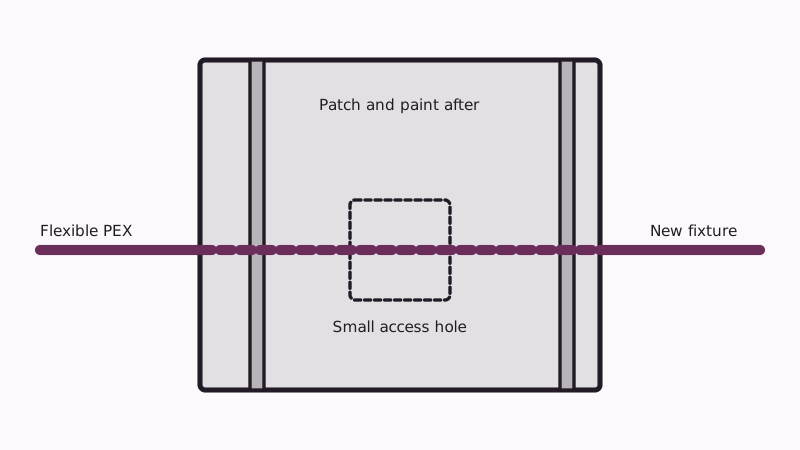
Plaster over lath, common in older Orange and Fullerton houses, is harder to patch than modern drywall. Tile or a tub surround sitting on a pipe path can add an opening. A thorough quote states where those holes go and whether patching and paint are in or out of the price.
If the material is still undecided, PEX versus copper sets them side by side.
What else lands on the final bill?
Typical extras: permit fees, drywall and paint, reconnecting fixtures, a new regulator or main shutoff, and repairs uncovered once the walls are open. Quotes either bundle them or list each one. The Building Division handles the permit, and Anaheim's application form has carried its own line for a water distribution repipe. Fee amounts shift with city updates, so check the present schedule before relying on any old figure.
Ask that the quote spell out:
- the pipe material and grade
- how many fixtures get new connections
- where access openings go and who closes them
- permit and inspection charges
- the hours the water is off each day
- whether old pipe is pulled or left in the wall
Hold a reserve for surprises. A rusted stub or a failed valve at the meter can hide until the job is underway.
Why does this region see so many repipes?
Two reasons: age and water. Plenty of Anaheim, Fullerton and Orange houses got their water lines in galvanized steel or early copper, and rust inside galvanized narrows the bore until the shower dribbles. The city utility reports hardness near 18 grains a gallon, which crusts hot-water lines over time. Rust-brown water, pinholes and falling pressure typically start the conversation.
Read reasons to repipe a house for the warning signs, replacing the plumbing of an old house for what turns up in the oldest homes, and galvanized pipe replacement if rust is your issue.
Common questions
Will the city want a permit for this?
It does. A repipe counts as altered plumbing on private property, and Anaheim asks for a Building Division permit plus an inspection. The plumber doing the work normally files for it and books the inspector. Look for the permit fee on the quote, and ask directly whether it is already included.
How many days will the house be torn up?
Guides suggest three to five working days with PEX and five to seven with copper for a standard house, longer for slab foundations or two stories. Pipe-running is sometimes quicker, with patching and paint trailing behind. Most people stay home throughout, accepting a few hours each day without running water.
What would one bathroom or a condo cost?
Fixture count and access set the price, so one bathroom runs well below a whole house, though not proportionally, since the plumber still has to tie in at the main. Condos add association rules and shared walls. Request a quote that separates your unit's pipe from any line shared with neighbors.
Is the expense justified for my house?
When leaks keep recurring, water turns rusty, pressure has faded, or the house still has polybutylene or failing CPVC. It rarely pays on healthy copper without leak history. Resale value and insurer attitudes to old materials can tip things, so ask your insurer before settling on a material.
Roughly what does a small house run?
At about 1,000 square feet with a single bath, the per-foot guides imply $3,500 to $7,000 for PEX against $8,000 to $14,000 for copper, patching not included. Small houses often cost more per square foot because the permit and setup are fixed costs spread across less pipe.
For what the work involves beyond the price, see plumber in Anaheim.
Sources
- City of Anaheim, Plumbing Permit Application (fee schedule lists a water distribution repipe line)
- City of Anaheim, water hardness (about 18 grains per gallon)
- Published whole-house repipe price guides and calculators, checked November 2026
Last updated