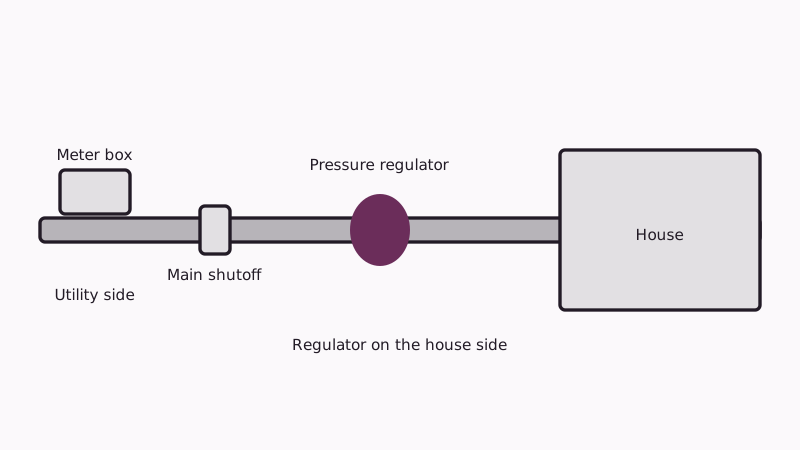
Look on the main supply pipe where it enters the house, typically downstream of the main shutoff. The regulator is a brass fitting shaped like a bell, roughly fist-sized, with an adjusting screw or bolt on its crown. Common spots are a wall outside, inside the garage, a utility closet or close to the water heater. Cannot find one? Your house may not have one, which matters for pressure problems. This page sits under low water pressure because the regulator is the first suspect when pressure is too low or too high.
How do I recognize a water pressure regulator?
Expect a domed metal body, usually brass, spliced into the pipe. A bolt or adjusting screw with a locknut crowns it, and an arrow often marks flow direction. It looks nothing like a plain shutoff valve, which has a handle or a lever.
Compare with the other parts near the main. The shutoff valve is a lever or a round wheel. A backflow device, if present, is larger and has test cocks. A thermal expansion tank, if you have one on a closed system, is a small tank by the water heater, not on the main line. A regulator has a neck with an adjustment screw.
If the bell has a tag with a pressure rating or a brand name such as Watts or Wilkins, you have found it. Take a photo for later.
Where do I look in a typical Anaheim or Fullerton house?
The three most common spots are the front or side exterior wall where the line enters, the garage wall near the water heater, and a utility closet. In slab-on-grade houses the line often rises out of the slab at one of these spots. In raised-foundation houses, which are common in older neighborhoods, it may be in the crawlspace, under the floor near the entry.
A walk-around works well. Start at the water meter in the sidewalk or street box, then follow the pipe toward the house. The meter and its box belong to the utility. The pipe on the house side is yours, and a regulator sits on the house side, not in the meter box. Check the front of the house, then the garage, then the side yards, then the water heater closet.
Photos of the main shutoff help, since the regulator is generally within a few feet. Our page on burst pipe prevention shows why knowing both valves is worth the effort.
How do I know whether my house has one at all?
Sometimes houses have none, or the original has been removed. If you see only a gate or ball valve after the meter and no bell-shaped fitting, you may not have one. A pressure gauge on a hose bib will tell you whether you need one, which is the practical question.
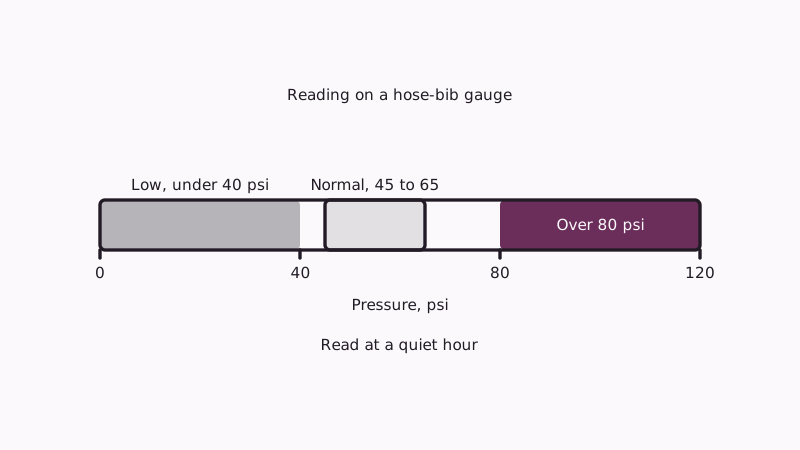
Fit a low-cost gauge to a hose bib, open the tap, and read the dial, ideally at dawn or late at night when pressure peaks. A San Diego County water district, Padre Dam, quoting the California Plumbing Code, says pressure where water is used must not exceed 80 psi, that a regulator is required above that, and that normal indoor pressure runs 45 to 65 psi.
Anaheim's own guidelines say much the same for its customers: when static pressure climbs past 80 psi, a regulator goes on the customer's plumbing, installed to code under the city's building division. Anaheim's rules also describe the meter and the service pipe up to it as utility property, and on-site pressure equipment as the customer's.
What about Anaheim Hills, hillside lots and HOAs?
Hillside lots are where regulators matter most. Pressure builds as you descend a slope, so a house at the foot of an Anaheim Hills or Yorba Linda street may see far more pressure than one at the crest. Check the gauge reading on a low lot, and do not assume the previous owner left a working regulator.
Anaheim's documents note that the utility's pressure can vary with topography and demand. Under its published rules, the utility generally maintains at least 25 psi at the service connection and no more than 175 psi, which is why a regulator on the house side is the way to bring a high-pressure lot down to a safe level.
In an HOA, ask who owns the lines. In a townhome or condo, a single regulator may serve several units from a common utility room, which the association maintains. Check your documents and ask the HOA before you adjust or replace anything, because adjusting a shared regulator affects your neighbors. In a standalone home inside an HOA, the regulator is generally yours.
What shows that the regulator is failing?
Put a gauge on it. A reading well beyond 80 psi suggests a failed or missing regulator. Weak flow at every fixture with a reading under roughly 40 suggests a regulator set too low, a valve left partly shut or a clogged screen. Banging pipes and a noisy house point to high pressure.
Other signs of a failing regulator: pressure that swings, a loud hum or knocking when a tap closes (see water hammer sounds), faucets and toilets that fail early, and a supply that creeps up at night. Regulators wear out, and a plumber can test and replace one. The other causes are covered in reasons for low pressure and house-wide pressure fixes.
Can I adjust or replace it myself?
Adjusting is within reach of many homeowners: slacken the locknut, give the screw small turns, and check the gauge between turns. Replacing is usually a plumber's job, because it means cutting into the main line, and a permit may apply. A badly set regulator can leave you with weak flow or too much force.
Our guide to adjusting a regulator valve shows the steps, and pressure regulator replacement and the page on a whole-house regulator go into the replacement side. For prices, see regulator installation cost.
A plumber is needed if the bell leaks, the screw has no effect, or the gauge reads high and no regulator turns up. The state contractor board sets $1,000 as the license threshold, and permit work requires one at any price.
Common questions
Does every home come with a regulator?
No. Many homes have one, some never did, and some have one that has failed, which is why testing matters. Your pressure decides whether you need one, and the plumbing code calls for a regulator above 80 psi. A gauge reading settles it, and a plumber can confirm that.
Is the regulator before or after the shutoff valve?
Usually after it, so you can close the main and work on the regulator. The order on the line is typically meter, then main shutoff, then regulator. Some houses differ, and in some the shutoff sits at the meter box, so follow the pipe.
Is a regulator the same thing as an expansion tank?
A regulator controls incoming pressure on the main line. An expansion tank sits near the water heater and absorbs the extra volume when water heats. A regulator can turn the plumbing into a closed system, so a plumber may add an expansion tank to protect the heater.
How often should a regulator be replaced?
There is no fixed date. Many last for years, and they fail as the diaphragm and spring wear. Replace one when pressure swings, creeps up, or the unit leaks. Annual pressure checks with a gauge catch problems early.
Need help finding or testing it? Share the details on the quote page, or visit the Citrus Belt Plumbing home page.
Sources
Last updated