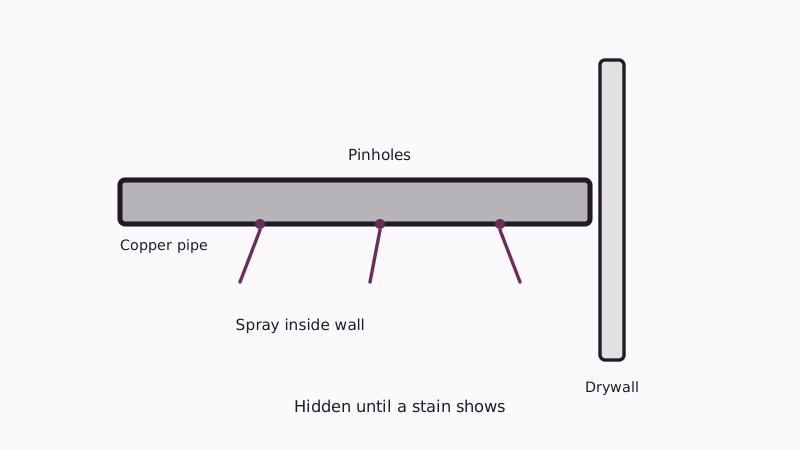
A pinhole leak in copper is a small hole, often no wider than a pin, where corrosion has worn through the pipe wall. It may spray a fine mist inside a wall or weep for months before a stain shows. One hole is a repair. Several holes in one house tell a bigger story, and the burst pipe plumber page is where we explain how help gets arranged once water is moving.
What does a pinhole leak look like?
Clues include green or white crust on a pipe, a damp patch that keeps coming back on a ceiling or wall, hissing while every fixture is closed, a musty smell, and a bill that creeps up though nobody changed their habits. Behind a wall, a stain or a spot of mold is typically the first sign.
Pinholes hide well because the water exits as a thin jet that hits the back of drywall or insulation. Floor that feels warm underfoot hints at a hot line, and a dial that spins in an idle house shows water is leaving. The EPA's method applies: note the dial, wait two hours, read it again. The same tests get more room in spotting a burst pipe.
Why do copper pipes get pinholes?
Research summarized in a Maryland task force report ties pinholes to a mix of water chemistry factors: higher pH, low organic matter, aluminum solids and free chlorine. Water velocity, hot water, and low pH also come up in other sources. In every case the result is pitting, where the protective layer breaks down in one spot and corrosion eats through.
The honest answer is that sources disagree on which factor matters most, and it can differ between water systems and houses. A plumber can say whether the pipe shows pitting from inside or damage from outside, such as contact with a different metal, a nail or a flux residue. What you can do is note where the holes appear: on hot lines only, near the water heater, or at bends where flow is fastest.
Local water is a mix of groundwater from the Orange County basin and imported supply, and the utilities publish their water quality reports. Anaheim's own hardness page lists about 300 ppm, which is hard water, but hardness itself is not named as the main cause of pinholes. If you are curious, ask your supplier for the pH and disinfectant levels in the report, and mention that to the plumber.
Is there a quick, temporary fix for a pinhole?
As a stopgap, yes. Shut the supply, empty the line, and make the pipe bone dry. Then use a clamp with a rubber liner, a silicone wrap that bonds to itself, or two-part pipe epoxy. Any of them might last days or weeks rather than years, since the wall around the hole is already thin.
Choose the clamp where you can reach the pipe: slide it on, seat the rubber over the hole, tighten in even steps. Epoxy demands a dry surface and the whole cure time, so when water cannot be stopped completely, the clamp wins. Afterward, check the spot each day and watch the meter. The limits of a patch are spelled out in mending a pinhole in copper tubing.
What is the lasting repair?
The plumber removes the damaged stretch, splices in fresh copper or another pipe material with solder or a mechanical fitting, and pressure tests the result. Any wall that had to be opened gets patched later. Dabbing solder over the hole itself rarely works because corroded metal does not accept it well.
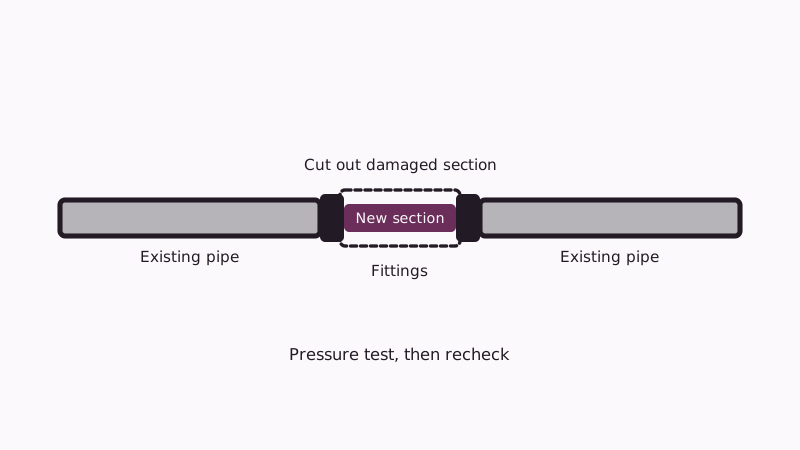
The new section should be tested at pressure and checked again after a day. Because one pinhole often means thin metal nearby, the plumber may look along the same run for other weak spots, especially on the same line. Larger replacements may need a city permit, and each city sets its own procedure through its Building Division, so raise it when the quote comes in. State licensing rules start at $1,000 for labor and materials together, and the matching class for plumbing is C-36.
When does repiping beat repair?
When pinholes keep appearing, two or three in a year, in different places, the pipe is failing throughout, and patching each one costs more over time than replacing the line. Repiping may be a section or the whole house, using PEX or new copper. A plumber can assess how widespread the damage is.
Weigh these factors:
- Number and spread. Holes along one hot line suggest a section replacement; holes on several lines suggest a whole-house plan.
- Damage so far. Wall and floor repairs add up, and so does mold remediation.
- Pipe age. Copper in older Anaheim, Fullerton and Orange homes may be decades old; some neighborhoods have galvanized steel in places too.
- Access. Slab-embedded lines can be rerouted overhead instead of dug up.
Read our pages on repiping a house, PEX versus copper and the cost to repipe before you compare bids. If the leak might be under a floor, slab leak detection and repair is the relevant page, and the cost of finding a hidden leak is covered under leak detection pricing.
What should I do today if I have found one?
Close the valve on the affected line, or the main if that valve is unknown, then open a faucet to bleed off pressure. Take pictures for the insurance file, carry belongings out, and run fans to dry the area. After that, send a note through the quote form saying where the leak sits and how many you have found.
Common questions
How long do copper pipes last?
Copper can last for decades, and many homes keep original lines for a long time, but water chemistry, flow and installation quality change that. A pinhole is a sign of local failure, not a countdown for every pipe, though several holes suggest the line is wearing out as a whole.
Can a pinhole leak get worse?
Yes. A small jet can widen as the metal erodes, and neighboring spots may also be thin. Water can damage drywall, insulation and flooring, and mold can follow. Treat even a tiny leak as urgent, and shut off the line until it is repaired.
Will homeowners insurance pay for it?
Policies differ widely. Some policies cover a sudden flood yet exclude the failed pipe and leaks that ran quietly for months. Read your own policy, document everything and ask the insurer directly. What insurers are asked about burst pipes lists the questions worth raising.
Can I solder over the pinhole myself?
Not reliably. Corroded copper rarely takes solder, the pipe must be completely dry and drained, and a torch near wood framing is a fire risk. A clamp is the safer stopgap, and the permanent fix is a replaced section by a plumber.
For the wider picture, start with plumber anaheim.
Sources
Last updated