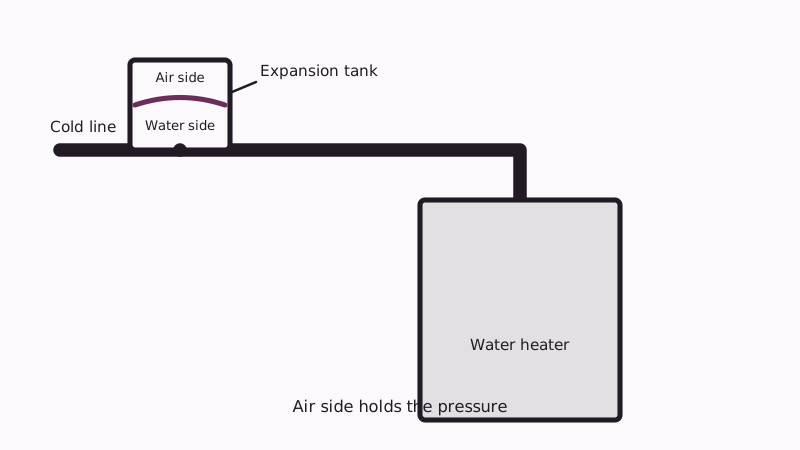
An expansion tank gives heated water somewhere to go. Warming makes water take up more room. On a closed plumbing system that surplus has no exit, and pressure climbs. A good tank soaks it up with a bladder and an air cushion. If yours has failed, a plumber can replace it, typically for about $150 to $450 installed. Checking the tank is a normal part of water heater repair, and the water heater plumber page covers the wider job.
What is the little tank above the heater actually doing?
A flexible rubber membrane splits the tank into a water side and an air side. When heating swells the water, the surplus flows in and squeezes the air, so line pressure holds steady. As the water cools, the air pushes it back out. A tire-style valve on top lets an installer set the air side.
Picture a small propane cylinder, often two gallons for a 40 or 50 gallon heater, hung from the cold line near the heater or sitting on top of it. Take it away and the swollen water has no outlet, so the spike lands on the relief valve, the heater and every fixture.
Do you need an expansion tank in California?
Often yes. The code asks for expansion control wherever the system is closed. A pressure-reducing valve, a check valve or a backflow device stops swollen water from drifting back toward the street main, and that is what closes it. A regulator where the water enters the house is common, and it makes the whole house a closed system.
Check with your city's Building Division, because enforcement runs through local permits and inspections, and ask whether your house counts as closed. A backflow device on the service line closes the system too. If a plumber replaces your water heater, an inspector may look for the tank, so it commonly goes in alongside.
How can you tell the tank has given up?
Watch for a relief valve that drips, pressure that jumps while the heater runs, knocking pipes and fill valves or faucets that wear out early. Two quick tests help: knock on the tank and press the air valve. A tank that sounds solid from top to bottom, or squirts water from the valve, is waterlogged.
Do the tests carefully. Hot water and pressure can scald, so turn off the heater, let the tank cool and never open the relief line. If the air valve spits water, the membrane has ruptured and the tank has to go. Air means the tank may be fine, though its charge still has to be compared with your house pressure.
A dripping relief valve points to a failed tank at least as often as to a faulty valve. If water keeps leaking from the relief discharge pipe for days, call a plumber. Capping that pipe is never the answer.
What is the working life of one of these tanks?
Most guides say about five to ten years, and the range depends on pressure and how the tank was set up. A tank with the right air charge on moderate pressure can last longer, and a tank set wrong or running on high pressure can fail in a few years. Replacing it when the water heater is replaced is common.
If your house pressure is high, say over about 80 psi, replace the regulator too, or the new tank will work harder. Pressure issues are a leading cause of pipe trouble, as we describe in what causes a pipe to burst.
Why does the air pre-charge matter?
The tank only works if its air pressure matches the water pressure in your house, usually somewhere between 40 and 60 psi. Many tanks come charged to about 40 psi from the factory. If your house runs higher, the diaphragm sits squashed and the tank barely helps, so the installer should set it with a pump and gauge.
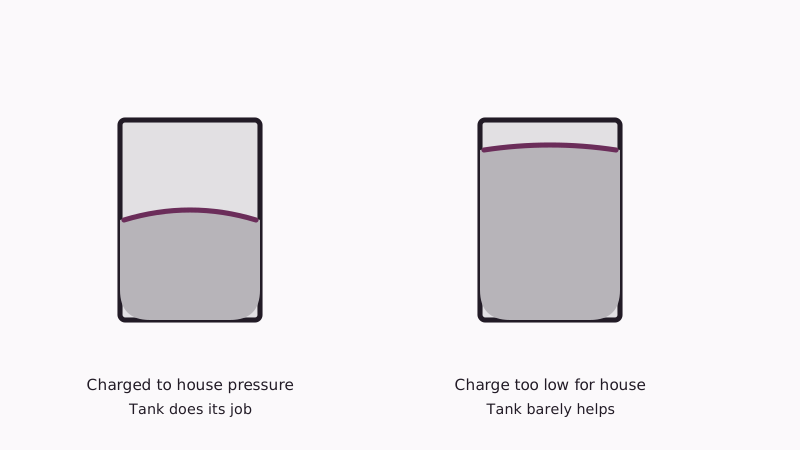
The right way to set it is to isolate the tank, drain the water side, and adjust the air to within about 2 psi of the static pressure you measure at an outdoor faucet with nothing running. Charging the tank while it is still full of pressurized water gives a false reading and is a common reason new tanks fail early.
Ask the plumber whether they check pressure first. A hose-bib gauge gives you the number to compare with the tank's label.
What should the replacement cost?
Published guides put replacement at about $150 to $450 installed, with the tank itself at roughly $40 to $60 for a two-gallon size and the rest as labor and a few fittings. A higher quote may include adding a new connection, a regulator or other work. The plumber should quote it before starting.
The price moves with the job. A simple swap on an accessible line is quick. Adding a tank where none exists, moving it, or replacing tight or corroded connections costs more. Doing the swap alongside a heater replacement or a regulator job usually saves a second trip.
To see how the tank fits into a bigger water heater job, read about water heater replacement cost and pressure relief valve replacement. A pressure regulator replacement can come first if your pressure runs high.
Can you replace an expansion tank yourself?
Some homeowners do, but know the steps and the risks. You have to shut off the water, relieve pressure, and cut or unscrew the old tank's connection, fit the new tank on a proper support with a correct charge, and check for leaks. A mistake can leave a leak, a bent fitting or a tank set to the wrong pressure.
If your tank hangs from copper pipe, a heavy tank can strain the line, and old fittings may crack when disturbed. Gas water heaters add a safety layer, because work around the heater should not disturb the gas connection. Cities differ on permits for this kind of work, so ask your Building Division. If unsure, bring in a contractor with a state license.
Common questions
Does a tankless water heater need an expansion tank?
It depends on the system. A tankless unit holds very little water, so expansion is small, yet a closed system with a regulator or check valve can still build pressure as water heats in the line. Some makers and local codes still call for one. Check the manual and your city.
Is a dripping relief valve always a bad expansion tank?
No. A worn valve, high house pressure or an overheated tank can all do it. A dead or absent expansion tank is a frequent culprit, so test it and read the pressure before buying a replacement valve. The valve itself is covered under relief valve replacement.
Which way should an expansion tank be installed?
Most are rated for either vertical or horizontal mounting, but the maker's label rules. A heavier tank should have support, not hang from a thin pipe. It connects to the cold supply line near the heater, with a fitting that allows removal. Read the label before buying and hiring.
Can I just remove the expansion tank?
Where code and the system call for one, taking it out is a mistake, since pressure rises with each heating cycle and may damage the heater, fixtures and relief valve. A plumber can say whether yours is required and replace it if so.
What happens if I never replace a failed tank?
The pressure spikes keep recurring. Typical results are a dripping relief valve, loosened fittings, and early wear on toilet fill valves, faucets and the water heater itself. Ignoring the problem usually ends up costing more than the tank would have.
For the wider picture, start with Citrus Belt Plumbing plumber.
Sources
- Angi, water heater expansion tank installation (installed cost range)
- California Plumbing Code summaries from city building departments (thermal expansion control on closed systems)
- California Contractors State License Board, hire a contractor
Last updated