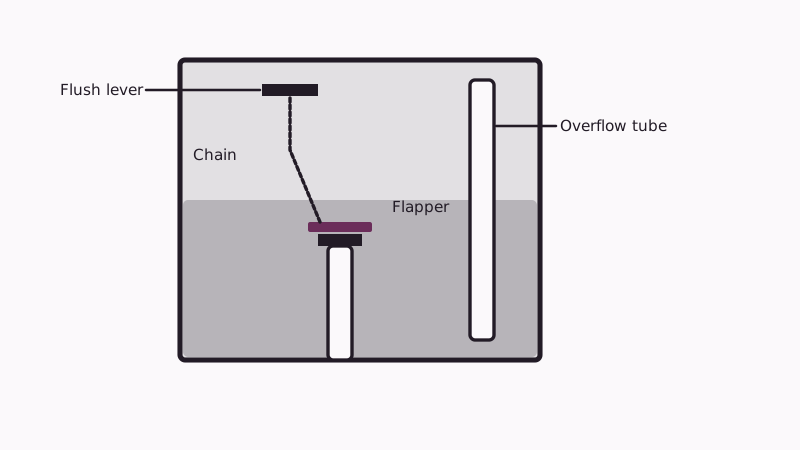
Repairing a flapper really means replacing it: unhook the old rubber seal, buy a twin, and clip it onto the pegs of the overflow tube. Twist the wall stop shut, let the tank run dry, and the new part goes in barehanded. When water still creeps past afterwards, the worn surface is usually the seat beneath it. Wider toilet faults, from fill valves to cracked tanks, live on our toilet repair page.
Is the flapper really what is leaking?
Confirm with dye. Dye is the proof. Squeeze food dye into the tank, then leave the handle alone for ten minutes. Tint in the bowl shows water is slipping past the seal, a test EPA describes. Flush afterward, because the dye can mark the tank.
Other hints include a tank that refills itself at odd hours, a faint trickle after midnight, and a bill that drifts upward with no explanation. The article on a high water bill walks through the meter side of the same hunt.
What should I look for when buying a replacement?
Two details decide it: the width of the opening it covers (commonly 2" or 3") and how it attaches, either with ears that hook over pegs on the overflow tube or with a ring that slides around it. Carry the old flapper to the shop, or photograph it together with the brand name stamped inside the tank.
A universal adjustable model suits most tanks. Some brands prefer an exact match, though. The notes on flapper valve types describe the common shapes in more detail.
What is the order of work for a swap?
Turn the supply valve clockwise and flush once, which empties the tank. Pop the chain off the flush lever, lift the old flapper's ears off the pegs, and press the new one into place. Rejoin the chain leaving a link or two of slack, reopen the valve and test. A taut chain holds the seal open.
Before fitting, wipe the rim of the opening with a damp cloth, since a thin mineral film defeats even a new rubber seal. In most tanks nothing more than your fingers is needed.
Why does the new flapper still let water through?
Suspect the seat, the ring of porcelain or plastic the flapper lands on. Run a fingertip around it. Pits, ridges or crusty scale mean no rubber will seal there. Light scale often rubs off with a soft scrub sponge, while a damaged seat needs a repair part.
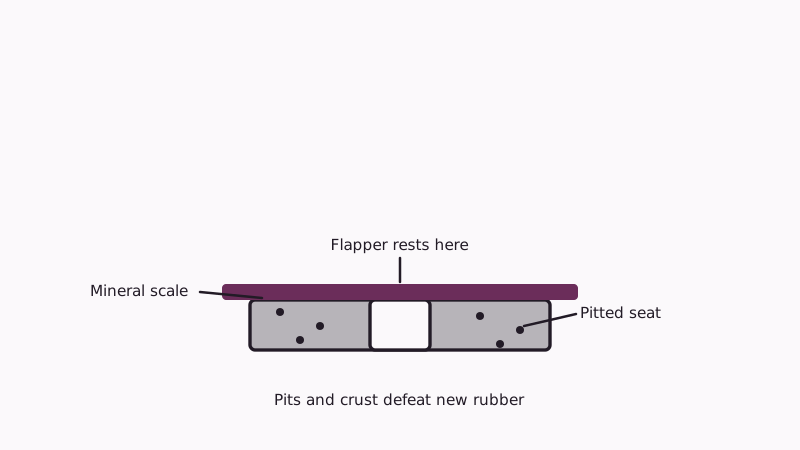
For that, Fluidmaster and Korky each market a 2 inch flush valve repair kit that adheres over the old seat, no tank removal required. These cover a worn seat, not a cracked valve body. The flush valve repair page goes through them.
Could chain length or water level be the real problem?
Yes, either one. The chain wants a link or two of looseness so the flapper can drop fully; tighter keeps it hanging open, and a chain that is far too long can slip under the lid. The ideal waterline sits near an inch below the top of the standpipe, and a level above that spills into the tube nonstop.
A fill valve that never quite shuts also imitates a bad flapper. If the tank keeps topping up after a new flapper, read about the fill valve repair, and for water seeping from the tank itself use tank leak repair.
What shortens a flapper's life?
Rubber stiffens, warps and gathers grit year by year, and mineral-rich water speeds that up. In-tank cleaning tablets are widely blamed for eating rubber, which is why plenty of plumbers tell people to leave them out. No fixed lifespan applies, because water, use and quality differ.
Hardness is a local matter. Your water supplier publishes an annual quality report with the figure for your street. Swap the flapper at the first hint of ghost flushing instead of waiting for a bill to announce it.
What tells me to stop and hire a plumber?
A wall valve that refuses to close, a hairline split in the tank, water pooling around the base, or a leak that outlasts a fresh flapper and a clean seat. Those point at the flush valve, a supply line or the wax ring under the bowl, and some jobs require lifting the tank.
An old toilet failing in several places may deserve replacing instead. See the toilet replacement cost page for scope, use our quote form to have someone look, or check toilet flush repair for symptoms that are not about the flapper.
What can a flapper cost me if I ignore it?
A seal that leaks a little every minute adds up. EPA's leak guidance suggests checking toilets first, and it counts more than 9,300 gallons lost per household yearly. A toilet that runs constantly can waste a lot more than that on its own, and the money shows up on the next two bills.
A silent flapper leak also hides well. Because the water never reaches the floor, nobody notices until the fill valve starts to cycle on its own. Checking once a year with a few drops of dye takes a minute, and finding a worn flapper early replaces a small part and spares a large bill.
Common questions
How can I separate a bad flapper from a bad fill valve?
A failing flapper lets tank water leak into the bowl, and then the tank tops up again. A failing fill valve does the opposite: the tank overshoots and pours down the overflow pipe. Look for a trickle in that pipe, and if dye reaches the bowl, the flapper is guilty.
Does any flapper fit any toilet?
No. Opening width and attachment style both count. An adjustable universal flapper fits many tanks, though a model sold for your brand sometimes seals better. A flapper that is too small or too large will not close properly over the opening, and the leak carries on.
Is paying a plumber for this worthwhile?
Parts cost little, so most of a visit's bill is the call-out, which makes a do-it-yourself swap reasonable. Hiring a plumber makes sense once other faults appear. No price is listed since it depends on the call-out and the state of the rest of the toilet.
Will a new flapper help a weak flush?
Occasionally. One that falls shut early cuts the flush short, and an adjustable model can be set to hover longer. Clogged rim jets or a low waterline also weaken a flush, and clearing a clogged toilet deals with the blockage side.
For the wider picture, start with the plumber guide for Anaheim.
Sources
Last updated