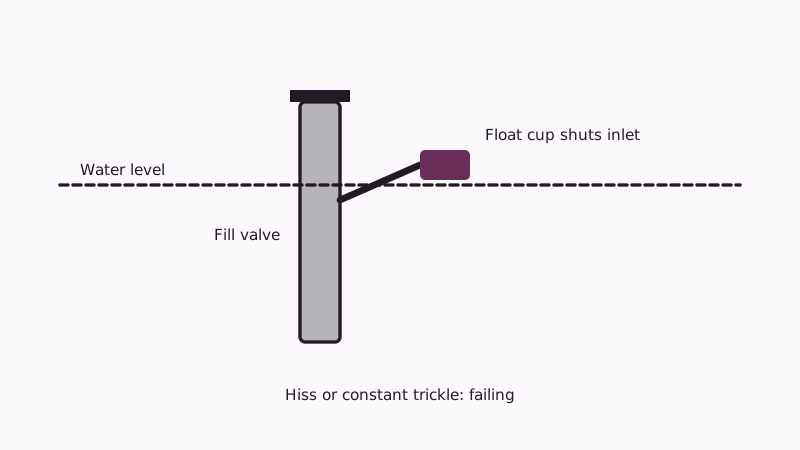
A fill valve that is worn out announces itself: a hiss after the flush, a tank that never quite stops filling, or a toilet that restarts on its own. Replacing it is one of the more approachable bathroom jobs, usually an hour or less with a wrench and a towel. Our toilet repair page covers when to hand a toilet to a plumber instead.
What does the fill valve do, and how do I tell it is failing?
The fill valve is the tall assembly in the tank that lets water in after you flush and shuts it off when a float rises to a set level. A failing one hisses, trickles into the overflow tube, fills slowly, fills too high, or never closes. The surest tell is water streaming into the overflow tube.
Wikipedia's overview describes the float lifting a lever or cup that closes the inlet as the tank fills, and notes that in older designs water pressure can slow the valve's closing, causing a hiss and a constant trickle. Types differ: classic ballcocks with a ball float, diaphragm designs, and the float-cup valves now common in most tanks. Hard water leaves grit in the seat, so Anaheim's water, which the city reports at about 18 grains per gallon, makes sticky valves more likely.
Is it the fill valve, the flapper or the flush valve seat?
Try the dye check. A dozen drops of dye go into the tank; the handle stays alone. If color appears in the bowl within ten minutes, EPA counts that as a leak, and it points to the flapper or its seat rather than the fill valve. If instead water climbs until it overtops the standpipe in the middle of the tank, the fill valve is not closing.
EPA's WaterSense page says old or worn flappers cause most toilet leaks, and they are inexpensive to replace. A worn flapper, or the seat it presses on, causes silent leaks, where the toilet refills every so often with no one touching it. A fill valve problem sounds like hissing and water that keeps flowing. Often both parts are old; see flapper repair and flapper types, and for a gasket-style flapper that has swollen or warped, a straight swap matched to the flush valve size is the usual fix.
What is the sequence for swapping in a new valve?
Turn the wall shutoff clockwise to its stop, then flush so the tank empties, and sponge out what remains. Take off the supply line, undo the big nut beneath the tank, withdraw the worn assembly, set its successor at the height in the maker's instructions, snug the nut by hand, reconnect the line and let the tank refill.
A fuller checklist:
- Prep. Lay a towel, set out a small bucket and keep a sponge handy. Photograph the old valve and refill tube.
- Remove. Spin off the coupling nut under the tank, then the lock nut, and draw the valve straight up.
- Set the new one. Set the height before mounting, usually by twisting the shank, so the critical-level mark sits above the overflow pipe's rim, as the maker specifies.
- Tighten gently. Hand-tight plus a small turn. Porcelain cracks if you force it.
- Hook up the refill tube. Clip it to the overflow tube and avoid pushing it deep inside.
- Restore water slowly. Open the shutoff, let the tank fill and check the connections.
- Set the water level. Most valves have a float or adjustment screw. The instructions give the final level, which stops short of that rim.
Read the package; models differ. If the shutoff valve leaks or will not close, stop and see the notes below.
What if the supply line or shutoff is the one that broke?
Phrases like "toilet burst pipe" usually mean a split supply line behind the toilet or a leaking shutoff valve. Shut the angle stop if it turns, or the house main if it refuses, then mop up. A braided supply line costs little to replace, but a corroded shutoff valve in an old wall can be a plumber's job.
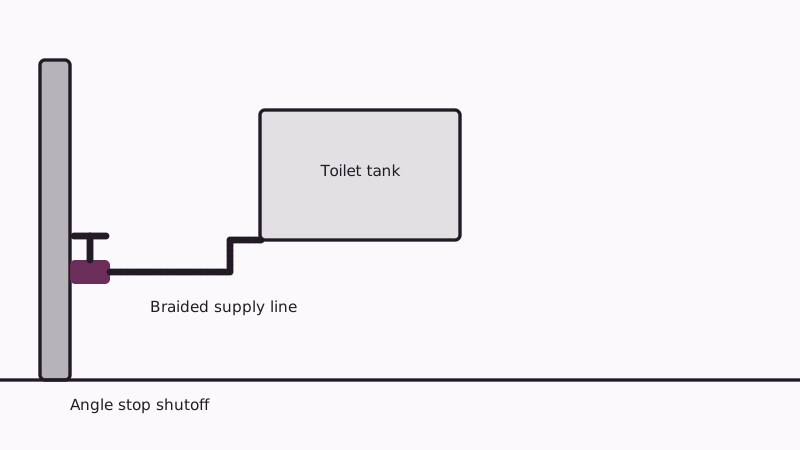
Never force a seized shutoff, which can snap and flood the room. Water spraying with a shutoff that will not budge means the house main goes off and the phone comes out. A leak that soaks flooring or drywall may call for drying and repair before reassembly. The guide to a leaking toilet tank covers drips at the tank bolts and base.
Can a running toilet make my water bill go up?
Yes. By EPA's figures, a typical household sheds upward of 9,300 gallons each year through leaks, toilets are a frequent source, and leaks can reach 180 gallons in a week. Toilets are close to 30 percent of indoor use, so a toilet that keeps running quietly shows up on the bill.
To confirm a toilet is the culprit, use the dye test, and EPA's meter check: write down the dial, give it two idle hours, then compare. A moved dial points to a leak. Replacing a flapper or fill valve costs far less than a year of lost water. See why bills run high and a toilet that keeps running.
When should a plumber handle the toilet instead?
Call someone in when the shutoff cannot be closed, porcelain is cracked, water seeps at the floor, the toilet rocks, or a fresh valve fails to stop the running. Lifting the toilet to fit a new wax ring is beyond a quick fix.
In California a contractor license only becomes mandatory at $1,000 for labor plus parts, a threshold a fill valve swap never nears. Prefer not to do it yourself? Head to the quote page. To weigh a full replacement, see what replacing a toilet costs.
Common questions
Is it worth changing the flapper while the tank is empty?
Often, yes. The two parts age together, and EPA says to replace flappers every five years at the latest. A stiff, warped or swollen flapper is a cheap swap that spares a second trip into the tank. Buy one sized to your flush valve opening.
Why does my toilet hiss after flushing?
A hiss means water is still entering the tank, either because the fill valve is not closing fully or the float is set too high and water is spilling into the overflow tube. Try adjusting the float. If the hiss continues, the valve seal is probably worn and the valve needs replacing.
How many years does a fill valve usually give?
The sources checked here give no fixed figure, though valves wear with use and with hard water. If yours hisses, fills slowly or will not shut off, treat that as the sign. Anaheim's hard water can leave grit in the seat, so a valve may fail earlier than in soft-water areas.
Do I need new parts for the shutoff valve too?
Only when it drips or will not turn. In that case, replacing the shutoff along with the braided supply line makes sense, though a plumber may be needed in older homes with corroded pipe. Close the house main before starting.
For the wider picture, start with plumber anaheim.
Sources
Last updated