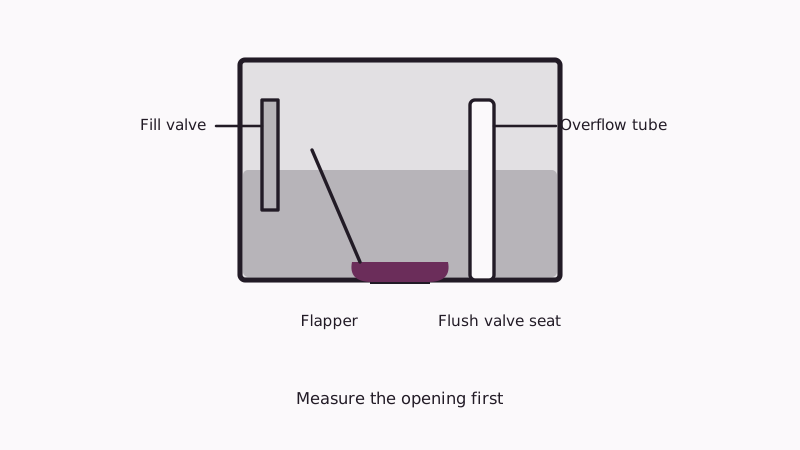
What matters is the width of the flush valve opening, normally 2 or 3 inches, plus the seal design: a hinged flap, or a canister that rises vertically. Measure the opening, note the toilet's make and model, and buy to match. A wrong-size part is the usual reason a brand new flapper still leaks. For help with the whole toilet, see our toilet repair plumber page.
What does a flapper do in a toilet?
The flapper rests on the tank floor and is made of rubber or silicone, acting as the seal. It holds water back until you flush, then lifts so water rushes into the bowl, then drops back to reseal. Once it wears, tank water creeps past into the bowl and the fill valve keeps refilling, so water is wasted day and night.
EPA says household leaks can waste about 180 gallons a week, that toilets are a common source, and that most toilet leaks come from aging flappers. A running toilet that restarts itself every so often, or a hiss at night, is the classic symptom. The fix is cheap, but it has to be the right part.
What are the main types of toilet flapper?
There are four you will meet: a standard 2-inch flapper, a 3-inch flapper, an adjustable or universal flapper, and a canister-style flush valve seal that takes the flapper's place completely. Dual-flush toilets have seals of their own. The difference is size, shape, how it attaches to the overflow tube and what flush volume it delivers.
Standard 2-inch. The classic hinged rubber flap with a chain, found on a great many older and mid-age toilets. It sits over a flush opening about 2 inches across.
3-inch. Same idea, bigger seal, for toilets with a wider flush opening that move more water faster. A 2-inch flapper will not seal a 3-inch valve, and a 3-inch flapper will not fit a 2-inch one.
Adjustable or universal. Wings, floats or weights let it fit several toilets. Handy when the original is out of production, but fit still depends on the model, and none is truly universal.
Canister. A tall cylinder that lifts straight up instead of swinging. Several makers, including Kohler and Toto in some models, use canister or tower seals that take parts specific to the model.
Dual-flush. Two flush volumes, usually a push-button with a seal on the valve under it. Parts are model-specific.
How do you measure the flush valve opening?
Close the little valve on the wall, flush the tank dry, and take a ruler across the hole the flapper covers. An opening of about 2 inches is roughly the size of an orange. About 3 inches is closer to a grapefruit. Buy the flapper that matches that number.
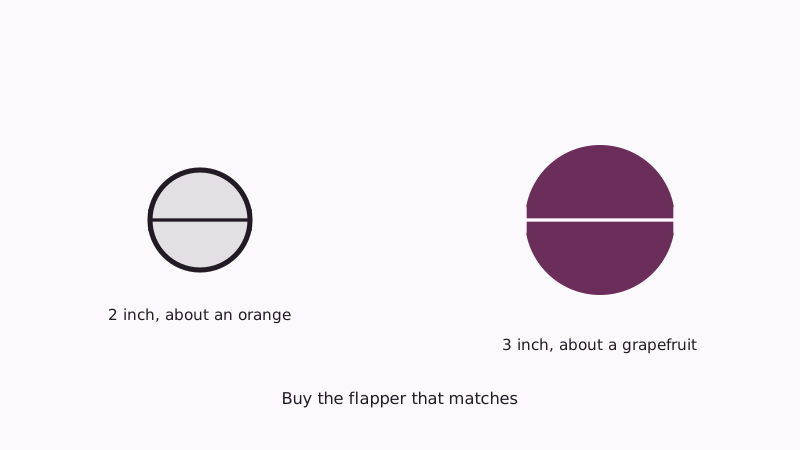
Do not guess from the age of the toilet, the brand or the gallons per flush. Age is only a rough guide: many older toilets use 2-inch flappers, but newer low-flow models may use either size. You can also measure the old flapper, since a flapper about 3 inches across typically fits a 2-inch valve, and about 4 inches across fits a 3-inch valve, according to one major parts maker. If the valve is wider than 3 inches, you need a 4-inch size.
Take the old flapper with you to the store as a second check.
Which brand and model of flapper should you buy?
Go by the toilet's make and model where you can. A maker's name and model code are usually printed under the tank lid or on the back of the bowl, and the owner's manual names the flush valve part. Brands such as Kohler, Toto and American Standard ship their own seals on certain models, and a generic flapper may not suit a canister or tower.
When the model is unknown, use the opening size and the attachment style as your guide: does the flapper hinge on ears at the overflow tube, or on a ring, or is it a canister? Generic adjustable flappers from a hardware store cover many cases. If you buy one, take care that its float or weight is set so that it closes cleanly.
For a canister seal, replace the whole seal assembly with the model-specific one. On some designs the flush valve can be changed with the tank left in place, a job covered on the page about changing a flush valve in place.
What is the routine for fitting the new one?
Water off, tank empty. Take the old flapper off the pegs on its tube, release the chain, and fit the new piece the same way round. Leave the chain slightly slack, roughly a pencil's width, or it will prop the flapper off its seat. Turn the water on and test.
Clean the seat first. Scale or slime on the rim of the flush valve keeps a new flapper from sealing. Water here runs hard, so scale is common. Wipe the rim with a rag or a non-abrasive pad. Check the chain for kinks and the length for snags.
If it still runs, look at the water level compared with the overflow tube, and after that at the fill valve. The next checks are laid out in toilet flapper repair, running toilet repair and toilet fill valve repair.
How can you tell it is the flapper and not something else?
Put a little food dye in the tank water, then wait ten minutes without touching the handle. Tinted bowl water tells you the seal or its seat is leaking. EPA lists this same dye test as the standard check. No color means look at the fill valve, water level or overflow tube instead.
A flapper leak is silent and shows as a restart, a hiss or a higher bill. A tank leak from the base or bolts shows as water on the floor, which is a different job: see leaking toilet tank repair. Flush the toilet right after the dye test to avoid staining the tank.
When does a plumber make sense?
Reasons include a cracked or pitted valve seat, a canister or valve that needs replacing, an old model whose parts are scarce, or a toilet that goes on leaking after a good flapper. Past that point a new toilet can be the cheaper route, and toilet replacement cost shows what is involved.
WaterSense models flush on 1.28 gallons or less, against the older 1.6-gallon standard, and EPA says an old toilet swapped for one can save 20 to 60 percent of toilet water. For a visit from a plumber, begin at the quote page.
Common questions
When should a worn flapper be swapped out?
There is no fixed schedule. Rubber and silicone wear out, and hard water and some owners find in-tank cleaners speed it up. Many flappers last several years. Replace it when the toilet runs on, the dye test shows a leak, or the rubber feels soft, warped or gritty.
Are all toilet flappers the same size?
No. The two common sizes are 2-inch and 3-inch, and a 4-inch size exists for wider valves. They are not interchangeable, so measure the flush valve opening first. For canister or dual-flush toilets, buy the part made for that model.
Will a universal flapper do the job?
Often it will, provided it suits your valve size and is adjusted so it closes cleanly. No flapper is truly universal, though, and on canister or tower style flush valves a generic one may not fit at all, so check the packaging against your measurement.
What if the toilet still runs after the swap?
Look at the size first, then the chain (too tight, or snagged), the seat (dirty or pitted), the water level (above the overflow tube?) and the fill valve (worn?). Clean the seat, adjust the chain and check the fill valve before replacing anything else.
Do I need to hire someone for this?
No. It is one of the easier toilet repairs, and a homeowner can do it with the water off. A plumber is worth calling if the valve seat is damaged, the toilet leaks at the base, or the fix does not hold.
This guide is one of many on plumber anaheim.
Sources
- EPA WaterSense, residential toilets
- EPA WaterSense, Fix a Leak Week (toilet dye test)
- Published flapper and flush valve sizing guides from plumbing parts makers and retailers, checked November 2026
- Toilet manufacturer owner manuals (model-specific parts lists)
Last updated