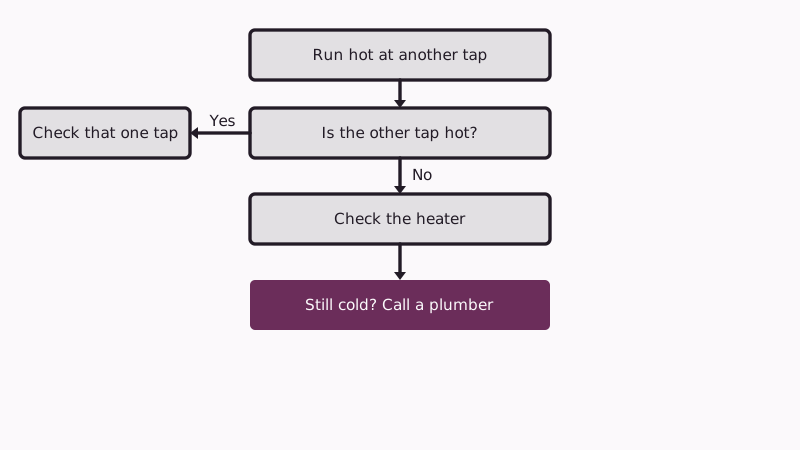
Walk to the bathroom and run the hot tap there. Cold everywhere? Suspect the water heater: a pilot that blew out, a breaker that tripped, a burned-out element or thermostat, or a tankless unit that locked itself off. Cold in only one spot? That is a fixture problem and the heater is probably innocent. This guide lives in the water heater section, and it stops where safe home checks end.
Do all the hot taps run cold, or just one?
Compare two taps in different rooms. If the second one runs hot, the heater works and the culprit sits at the first fixture: a worn cartridge, a clogged aerator, a failed shower mixing valve, or supply lines that got swapped during an earlier repair. If both are cold, the heater is where you look next.
Small clues sort things out. Hot that fades after a minute points to heater capacity. A single-handle faucet that only warms at one handle position often has a tired cartridge. A far bathroom that takes forever while the kitchen is quick usually means a long pipe run. For one cold shower, see shower with no hot water; for the kitchen alone, cold kitchen sink.
What can I check on a gas heater?
Look for a lit pilot or a status light, and confirm the gas valve handle is parallel to the pipe, which means open. If the manual shows a relight procedure and the pilot is out, follow it once. If the flame keeps dying, the thermocouple is the likely culprit. A gas smell changes everything: walk outside and call the SoCalGas line, 1-800-427-2200.
Do not relight again and again. The gas valve, the vent pipe and the relief valve are contractor work, and under state law that means a contractor with a California license. Related guides: pilot lit but no hot water, thermocouple swaps and gas valve replacement.
What can I check on an electric heater?
Go to the breaker panel first. Electric tanks run on a double breaker, and when it trips the whole tank goes cold. Flip it off and on one time. A second trip means a shorted element or a thermostat fault, so stop. Water and live wiring are a bad mix, and a plumber or electrician should take over.
Under the metal covers on the tank sit two thermostats and two elements, and the upper thermostat carries a small red reset button. Leave covers shut unless the power is off at the breaker. Elements fail often, and swapping a water heater element explains the repair. Hard water coats elements in scale, which is a regular story in North Orange County.
What if the heater is tankless?
Read the display for a fault code. Then confirm both valves are open, that an electric model's breaker is on, and that the inlet filter is clean. Tankless units need a certain minimum flow before they fire, and federal energy guidance warns that the sensor may miss a trickle. Scale inside the heat exchanger can also lock a unit out.
Flushing on the maker's schedule holds scale back. The page on a tankless heater with no hot water goes through codes and flow, and hard water scale prevention covers the buildup. If the display shows a code you cannot read, write it down and give it to the plumber.
What makes water lukewarm, or drain away fast?
Several things cause it: a dead lower element, a worn thermostat, sediment piled in the tank, a cracked dip tube that sends cold inlet water straight to the top, or a setting that is simply too low. Running out fast can also mean the tank is too small for how many people now use it.
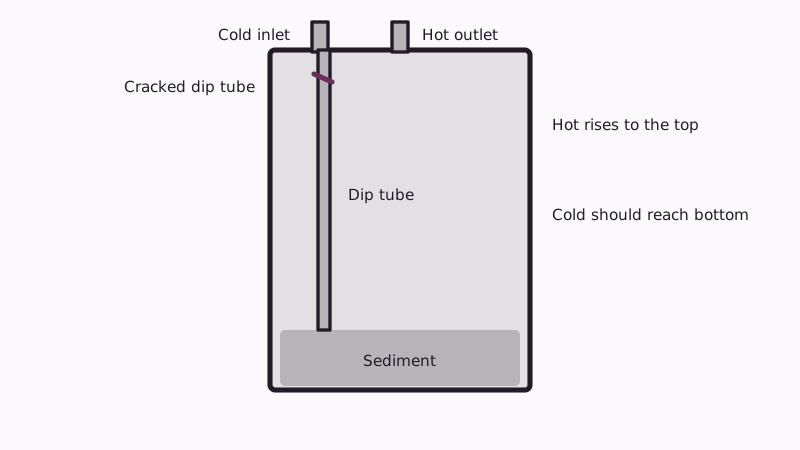
Check the dial before anything else. Federal product-safety guidance (CPSC) is 120 degrees Fahrenheit or lower to prevent scalds, and its publication notes 150 degree water can cause a third-degree burn in two seconds. So raise a dial to 120 at most. A bigger tank, not a hotter setting, solves a capacity problem. For more causes, see reasons for having no hot water.
Which no-hot-water problems are real emergencies?
Four situations: water pouring from the tank or relief valve, any gas smell, a loud banging heater, or standing water near electrical parts. In each case shut off the heater's fuel or power, close the cold inlet valve and call for help.
For a leak, the cold valve sits on the pipe feeding the top of the tank. Do not touch anything wet that is wired. The water heater emergency page lists the first moves. Once a tank leaks, nothing patches it, and age usually explains why; the usual replacement interval shows what to expect.
What will getting hot water back cost?
Most causes cost a good deal less than a new heater. A thermocouple, element or thermostat repair rarely tops a few hundred dollars in published guides, while a leaking tank means replacement. Ranges are in water heater repair costs, and the water heater price guide covers the swap.
When you book through us, a local plumber arrives, diagnoses the heater and writes up a price before work begins. Often the fix is a small part on an otherwise healthy tank. Past 10 to 15 years of age, replacement can be the wiser spend.
Common questions
How soon can hot water come back?
A relight, a breaker reset or a new thermocouple can restore hot water the same day. An element or thermostat is often a single visit, parts permitting. A whole new heater needs a longer appointment plus time for the tank to fill and reheat, so ask for a rough timeline.
What does a plumber need from me before arriving?
Be ready to say which taps run cold, when it began, which fuel the heater uses, how old it is, and whether you noticed a leak, smell or noise. Clear the way to the heater. Ask whether any diagnostic fee comes off the repair price.
Why is one faucet so slow to turn hot?
Mostly distance: cooled water sitting in the pipe has to flush out before hot arrives, so a faraway fixture waits longer. A recirculation pump or a closer heater helps. A clogged aerator or partly closed valve can add to the delay, and a sudden change deserves a look.
Could the problem be the faucet and not the heater?
Yes, when only one fixture is affected. A worn cartridge, a clogged aerator or crossed supply lines can leave one faucet cold while the rest work. Try the other taps first. When every tap runs cold, suspect the heater and use the checks above.
Ready for a visit? Explain what you see through the quote page, or begin at the Citrus Belt Plumbing home page.
Sources
Last updated