A tankless heater has no stored supply to fall back on, so when something stops it, the shower runs cold at once. The good news is that the causes sort into a short list, and the first few checks need no tools. Start here, and when you reach gas, venting or a flashing error code, call a plumber instead of pressing on. Our main water heater repair page covers tank units and the repair-versus-replace decision as well.
Why has my tankless water heater stopped making hot water?
Most often one of five things has changed: the unit lost power, gas stopped reaching it, water flow fell below what the unit needs to fire, scale or debris is blocking the heat exchanger or inlet screen, or the exhaust or condensate drain is blocked. The display on the unit usually shows an error code that points to which one.
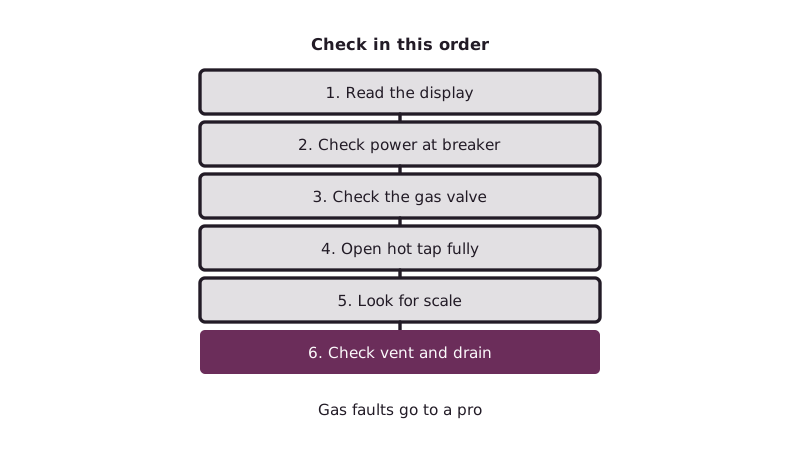
The order below goes from cheapest to check to most involved:
- Read the display. Jot down any error code, then find its meaning in the manual for your exact heater before you press reset.
- Check power. Confirm the outlet or breaker is live. Electric tankless units draw a lot of current, so a tripped breaker is a frequent cause.
- Check the gas. Make sure the gas valve at the unit is open, and see whether another gas appliance works. If none does, call SoCalGas.
- Check flow. Open a hot tap fully. A trickle can be too little to start the burner.
- Look for scale. Hard water leaves a crust that restricts flow and insulates the heat exchanger.
- Check vent and drain. A blocked exhaust or a clogged condensate trap on a high-efficiency unit stops it firing.
Can a weak trickle keep the burner from lighting?
It can. A tankless heater ignites only when water moves through faster than a minimum rate. Navien lists 0.5 gallons per minute for its NPE-210S2, which is roughly the flow of a barely open tap. A clogged aerator, a crusted showerhead or a half-closed valve can drop flow under that threshold and the burner never starts.
Run a quick comparison: throw a kitchen hot tap fully open and listen for the click of ignition, then try the shower. A heater that fires at one fixture but not the other is fine; the weak fixture is the culprit. Anaheim water sits near 18 grains of hardness per gallon, enough to choke aerators and showerheads with crust in months. Unscrew the aerator, let it sit in vinegar for an hour, refit it.
Tankless units also work badly with very low demand. Turning the tap on just a little to get "warm" can leave the heater cycling on and off. Running it at a steady, moderate flow avoids that.
Why does the water go hot, cold, then hot again?
You are feeling the "cold water sandwich". Hot water from the last use is still in the pipe, then comes a pocket of water that cooled in the line or sat in the heater, then fresh hot water once the burner catches up. Short gaps between uses make it worse. A recirculation loop or a small buffer tank smooths it.
Other suspects: a worn shower cartridge, or a cross-connection that lets cold water leak into the hot line. If only one single-handle faucet misbehaves, replace its cartridge before blaming the heater. If it affects the whole house, check that the heater's flow sensor is working. Navien's own FAQ covers a heater that makes no hot water and shows no code. It points to a flow sensor that is not spinning properly, and says cycling the pressure relief valve briefly may free it temporarily. A lasting fix needs the installer or a service specialist.
Can scale on the heat exchanger cause no hot water?
Yes. In hard water, minerals build up on the heat exchanger and clog the small passages and inlet screen, which reduces flow and heat transfer. The unit may overheat, trip an error code or shut down. Manufacturers recommend periodic descaling, a vinegar or descaler flush through service valves, with the schedule shortened in hard water areas such as ours.
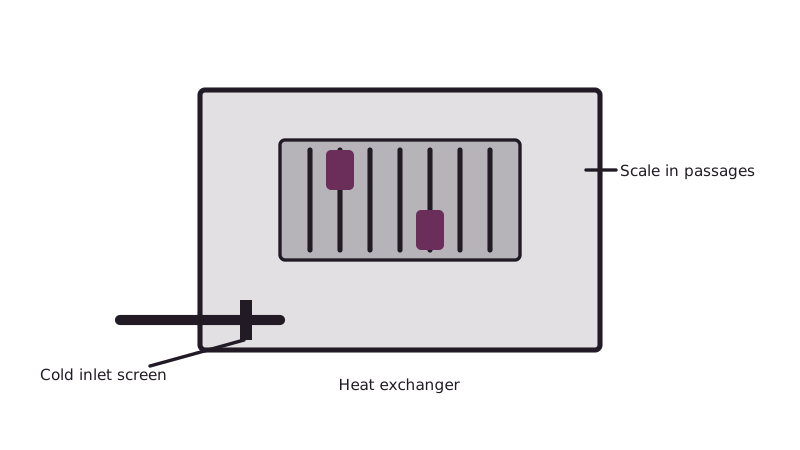
You can check the cold water inlet filter screen yourself: close the isolation valves, release pressure, unscrew the screen housing, rinse the screen and refit it. Do not take the unit apart further. A full descale uses a small pump and a few gallons of white vinegar circulated through the heat exchanger according to the maker's instructions, and a plumber can usually wrap it up inside an afternoon. Softened water upstream prevents most of the problem; see installing a softener.
When is it a gas or vent problem?
If the unit tries to light, clicks, and then shuts off with a code, the fault may be gas pressure, a flame sensor, the exhaust or the condensate drain. On a condensing unit, a blocked condensate trap or a crushed vent pipe can stop firing. Those faults belong to a plumber. If you catch the smell of gas, exit first. The SoCalGas number is 1-800-427-2200; place that call from outside.
Gas is where DIY stops. Do not bypass safety switches, enlarge vent openings or hold a switch to force ignition. Older Orange County houses may also carry gas pipe sized for a modest tank burner, which starves a tankless unit at full demand. The plumber measures pressure and the pipe size. For gas pipe size and cost, see gas tankless installation.
Is this heater worth repairing?
A repair pays off on a younger unit, say under a decade, when the trouble is a sensor, screen or scale. Replacement enters the conversation if the heat exchanger leaks or scale has wrecked it, or if the quote edges toward a new heater's price. The Department of Energy expects tankless units to run past 20 years, so most failures are worth a repair.
Published repair guides show typical water heater repairs at $150 to $750 overall, with an average near $450, according to Fixr. Get the diagnosis in writing. If the warranty has lapsed, set the repair beside a replacement; new-unit pricing is on the tankless installation cost page, and the design trade-offs are in tank versus tankless.
Common questions
What does a troubleshooting visit cover, and how long is it?
Reading the code and checking power, gas, flow and the inlet screen often fits within an hour. Descaling or swapping a part adds an hour or two. Gas pressure problems or a dead circuit board take longer, particularly when a part has to come from a distributor.
Which questions come before the repair starts?
Does the visitor work on your brand? Does the service charge count toward the repair? What would repair and replacement each cost? Does the part carry a warranty? Insist on the scope on paper; in California a home improvement contract over $500 must be written.
Must I be around while it is repaired?
At the start, yes: someone opens the door, shows the heater and gas valve, and approves anything past the diagnosis. Most of the time is spent at the heater, so you can keep out of the way, as long as you can be reached.
Can I just power-cycle it?
Turning the power off and on is a common first step in manuals and is normally safe. When the same code comes back, stop; repeated restarts on a gas unit with a flame or vent fault are unsafe. Soot around the unit or a gas odor means close the gas valve only if reachable, leave, and call for help.
Why does the water only run lukewarm?
The unit may be too small for what you run at once, set to a low temperature, or held back by a scaled heat exchanger. Two showers plus a dishwasher can overwhelm a tankless unit, which the Energy Department says typically delivers about 2-5 gallons a minute. Shut a fixture and test again.
For the wider picture, start with Citrus Belt Plumbing.
Sources
Last updated