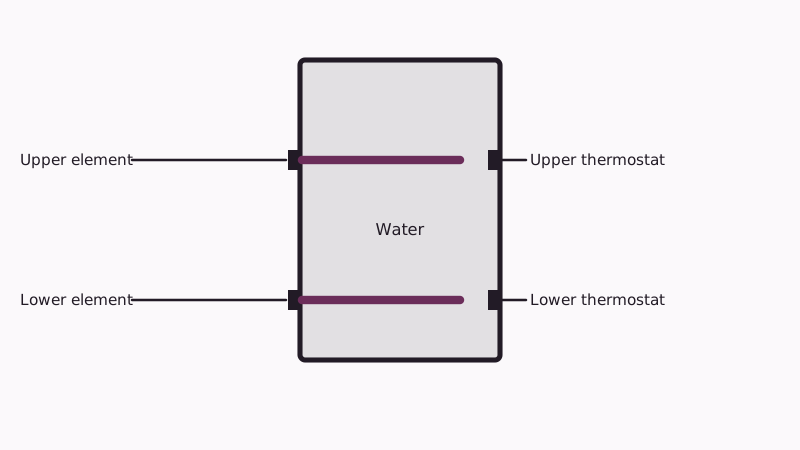
When an electric tank runs out of hot water fast, or never heats at all, one of its two elements has often failed. One published guide puts an element replacement with labor at $200 to $750; the part alone is a small share of that. Read the wider water heater repair page before you buy anything, because this symptom has other possible causes.
How do I know the element is the problem?
Two clues: water that is lukewarm or runs out after a few minutes, and a tripped breaker that keeps tripping. The sure test uses a multimeter on the element terminals with the power off. No continuity, or a reading far from the label's expected resistance, means the element is dead. A thermostat or high-limit reset can mimic it.
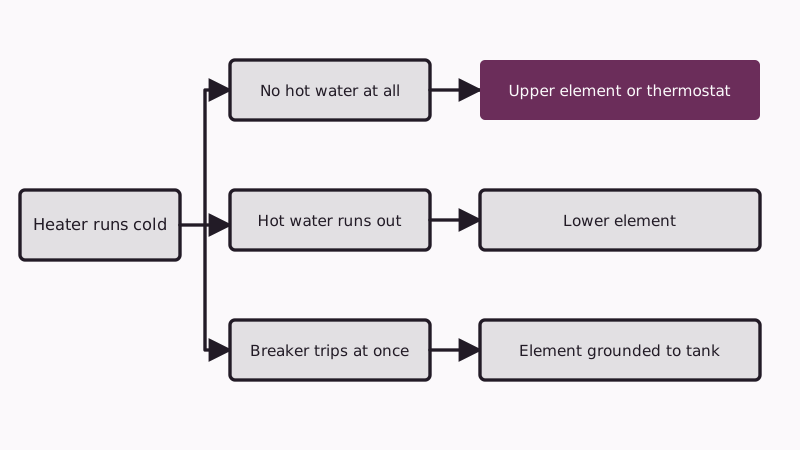
A rough field guide for a standard two-element tank:
- No hot water at all: the upper element, the upper thermostat or the high-limit reset button.
- Hot water but not much of it: usually the lower element.
- Breaker trips the instant power returns: an element grounded to the tank shell.
- Rumbling and popping: scale on the elements, not a failure yet.
Open the breaker at the panel, then prove the circuit dead with a non-contact tester before a hand goes near a wire. Mixing water and 240 volts leaves no room for error.
Which replacement element fits my heater?
Match four things printed on the old element and the tank label: voltage (almost always 240 for residential tanks), wattage (4,500 watts is common, 3,800 and 5,500 also exist), mounting style (screw-in with a 1-1/2 inch thread, or a flange held by four bolts), and length. The upper and lower elements can differ in wattage, so read the heater's data label.
Never put a higher-wattage element into a heater rated lower. It can overload the wiring and the thermostat. Take the old element with you to the parts counter, or photograph the label. Brands vary, but a manufacturer part number is the fastest route to the right match.
Some owners choose a "low watt density" element, which spreads heat over a longer surface and is often sold as better for water carrying minerals. Anaheim's latest water report shows hardness of roughly 16 to 19 grains, so mineral scale is a real factor in this city. The claim that low-density elements outlast standard ones is a common industry argument, so treat it as a reasonable bet rather than a promise.
How is the swap carried out?
Kill and test the breaker, close the cold inlet, drain until the water sits lower than the element, unhook the wires, remove the old element, seat the new one with a fresh gasket, fill the tank completely, and only after that restore power. Skipping the refill is the classic blunder.
An outline:
- Power off at the panel, tested dead.
- Cold inlet closed; hose attached to the drain valve; a hot tap opened upstairs so the tank can drain.
- Panel covers and insulation removed; wires photographed before disconnection.
- Element removed with a 1-1/2 inch element wrench, or the four bolts undone for a flange type.
- New gasket and element in; tightened firmly, not crushed.
- Wires reconnected, tank filled until water flows steadily from the hot tap with air purged.
- Panel covers back, then breaker on.
An element that is energized while exposed to air, or while the tank is not full, can burn out within seconds. That one mistake wastes the part you just bought.
What does a replacement element cost, parts and labor?
Fixr's guide lists $200 to $750 for a plumber to replace an element, labor included, and the written quote sets your price. Higher bills usually trace to a seized element, a corroded connection or extra diagnosis. Ask for the element part cost on its own line so you can see the labor.
These are guide numbers from published cost pages for the region, not a quote. The first element to fail is rarely the only worn part, so a plumber who tests both elements and the thermostats may add a modest charge for a second element in the same visit. For the full price picture, see water heater element replacement cost.
Is this a job for me or for a plumber?
A confident do-it-yourselfer who is comfortable with a tester and a drained tank can handle an element swap on a tank with accessible panels. Bring in a plumber if the heater is past roughly 12 to 15 years, the element will not budge, water seeps around the element port, or the wiring looks scorched. Electrical faults deserve a trained eye.
Swapping a part differs from replacing the heater, and the permit rules target the latter. Replacing the entire unit is permitted work in Anaheim, and California wants a contractor on any job that reaches $1,000 or needs a permit. If you cannot tell which side your repair falls on, ask the city's Building Division.
Age matters when you decide. The US Department of Energy models storage water heaters at around 15 years of average life in its rulemaking documents. If your tank is old and rusting, the money may be better spent toward a new unit; what a new tank costs is laid out on its own page.
What makes elements burn out early?
Scale, sediment, dry firing, and a failing thermostat. Hard water leaves mineral crust on the element sheath, which traps heat and cooks the metal. Sediment from a tank nobody ever flushed can bury the lower element. A leaking relief valve or a drain left open during service can expose an element to air, and that finishes it quickly.
Flushing the tank on the schedule in the manufacturer's manual clears much of the sediment, and a working anode rod slows corrosion of the tank itself; see anode rod replacement cost for that side of maintenance. A softener upstream of the heater cuts scale, though it has its own anode considerations.
Common questions
Do gas water heaters have heating elements?
No. A gas heater burns fuel at a burner under the tank, controlled by a gas valve and a thermocouple or igniter. Elements belong to electric tanks and to electric tankless units. If your heater is gas and runs cold, look at the pilot, thermocouple and gas valve instead, and check no hot water with a pilot lit.
Should I replace both elements together?
Many plumbers do, since both have lived the same years in the same water. The extra part is cheap insurance against a repeat visit. If only one tests dead and the tank is young, replacing just that one is reasonable. Ask what the plumber found when testing the second element.
Can I use a different wattage than the old element?
Match the heater's data label, not a guess. The label states the maximum wattage per element and the voltage. Lower wattage heats more slowly but is safe. Higher wattage than the label allows can overload wiring and thermostats, and it may void the warranty, so do not exceed it.
How long should a new element last?
There is no fixed number. In soft-water homes, elements often outlast many years. In hard water, scale shortens the span, and an element may last several years or fewer. Flushing the tank and keeping the heater in good shape stretches life. The Citrus Belt Plumbing home page lists our other plumbing topics.
Sources
- Published water heater element repair prices from cost guides, checked November 2026
- Fixr, water heater repair cost guide
- City of Anaheim Water Hardness
- City of Anaheim Building Division, when a permit is required
- US Department of Energy, water heater information
Last updated