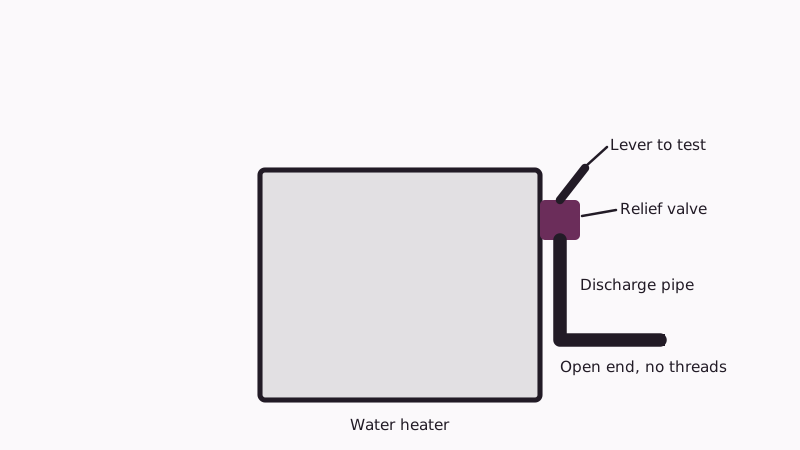
Replace a relief valve when it leaks steadily, is crusted with mineral deposits, or no longer lifts when you test the lever. It is a safety device, so a failed one should not stay on a heater for long. The valve, the discharge pipe and the heater itself belong to one system, which is why a valve problem often turns into a water heater repair conversation. Read on for the signs, the code, and the line between DIY and a plumber.
What makes this valve drip in the first place?
Three suspects: a tired valve seat, pressure in the house piping climbing past the valve's setting, or a thermostat set too high. A new valve cures only the first. When heating water pushes pressure up on every cycle, the fresh valve will start weeping as well.
Note the timing. Drops that appear soon after a heating cycle suggest expansion, while a steady trickle suggests a worn seat. An expansion tank tied into the cold feed frequently removes the first cause, as described under expansion tank replacement.
What does the valve do, and what does the label mean?
It is spring-loaded and lifts by itself when heat or pressure inside the tank climbs too far, letting water out so the shell is not stressed. Most are rated for both, hence the name T&P valve. California Plumbing Code section 504.6 calls for an approved relief valve on a storage water heater.
The part is sized to the heater's input rating. A shop clerk's best guess at a match is not good enough; read the heater's label and the old valve's markings, and take both to the counter or leave it to the plumber.
How can I test whether the relief valve still works?
Many manufacturers advise lifting the lever briefly once a year, so a short burst of hot water runs down the discharge pipe into a bucket or drain. Stand clear, since the water can scald. If the valve lets water out and then reseats without dripping, it is probably fine. If it stays stuck, or drips afterward, replace it.
Do not test it if the discharge pipe is missing, cut short or aimed at a floor where hot water would run onto people or pets. And never cap or plug the valve to stop a drip; that removes the protection entirely.
What does California code require for the valve and its discharge pipe?
The valve has to be an approved model. Downstream, the pipe needs the valve outlet's diameter, no shutoff or blockage, a downward run and an end without threads. A city handout summarizing the code adds that relief discharge into a heater pan is prohibited, and that the pipe material must withstand the water temperature.
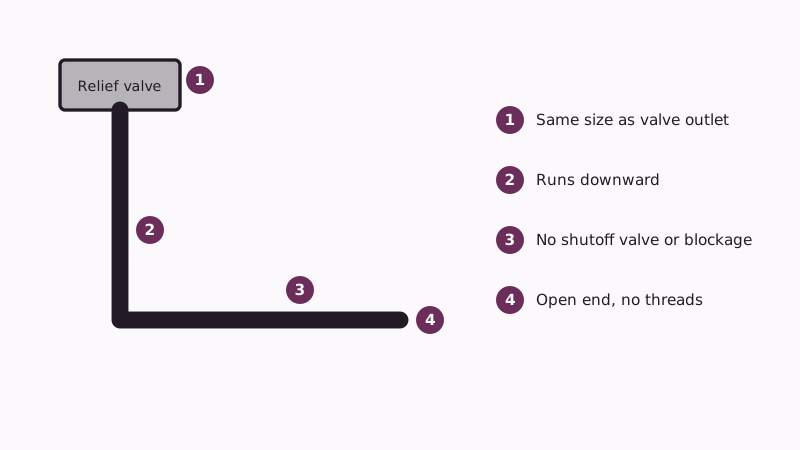
Those are summaries from a published city handout of the California Plumbing Code (sections 504.6 and 608.5). Local inspectors apply the code, so ask the Building Division of your city for details. The permit guide for water heaters explains the paperwork.
Is this a DIY swap, or a plumber's job?
Some handy owners do change relief valves. First the tank is relieved of pressure and part of its water, the thread seal has to suit hot water, and the discharge pipe must go back exactly as before. In Anaheim a water heater replacement counts as permit work, so anything beyond a like-for-like valve deserves a call to the city's Building Division.
Call in a plumber when the old valve refuses to turn, the threads are corroded, a gas heater's controls are in the way, or the pipe must be altered. In California, a contractor handles anything involving gas piping. Before touching anything near the tank, switch off the gas control, or the breaker on an electric one.
What if the new valve leaks too?
Then the cause lies elsewhere. Thread a pressure gauge to an outside spigot, because the code treats pressure above 80 psi as excessive, and look at the thermostat setting. A backflow device or check valve can seal the system, leaving heated water no outlet, and an expansion tank supplies the missing room.
A heater that is old may also be the real problem. Tanks that have rusted or lost their anode protection can leak and sputter. Typical lifespans are discussed under replacement frequency for water heaters.
What does the replacement usually cost?
A valve is an inexpensive part, and the cost of the visit is mostly labor, travel and the call-out. We do not publish a number here, because prices depend on access, the heater's location and whether other work is found. The separate page on relief valve replacement cost covers ranges. You can also send a request for a written quote.
Hot water pouring out hard, or a shell too hot to touch, is urgent: close the supply and consult water heater emergencies on the way to the phone.
Common questions
Does a tankless unit need one too?
A tankless unit holds very little water, so its protection is arranged differently. Some include a relief valve or another built-in safeguard, and some installations add a valve. Your model's manual settles it, and discharge piping rules still follow any valve that is fitted.
Is a dripping relief valve dangerous?
A slow drip is a warning and rarely an emergency. Pressure or heat is reaching the valve's limit, or the valve is simply tired. Steam, a rumbling tank or a hard flow of hot water is serious. Turn off the fuel and the cold feed, then step away from the heater and phone for help.
Is there a lifespan for the part?
No fixed one. Scale builds on valves in hard water and can freeze them in place after several years, hence the yearly lever test. If the tank is ancient, a fresh valve could be money wasted, so weigh it against water heater repair prices.
Does the replacement need a permit in Anaheim?
A water heater change-out in Anaheim goes through the Building Division, and the city's plumbing permit form lists a water heater fee. Only the Building Division can say if a lone valve swap needs a permit, and the plumber can bring it up when quoting. See the Citrus Belt home page if you want help starting a request.
Sources
Last updated