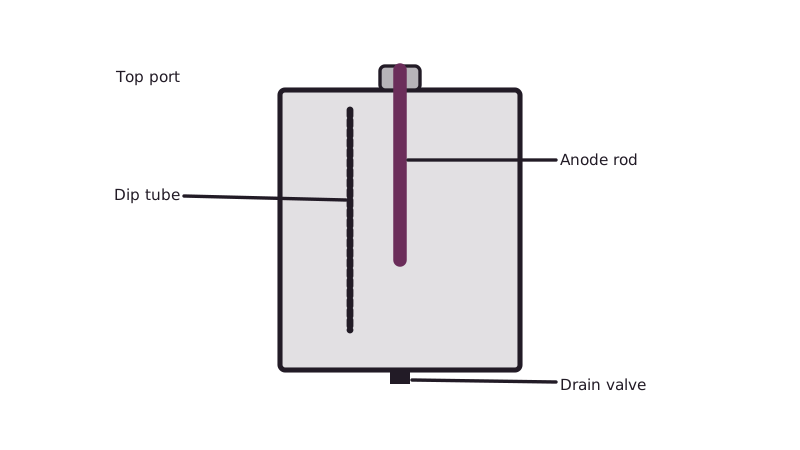
Most plumbers charge $150 to $350 to replace an anode rod, and some cost guides list up to $450. The part by itself is $20 to $50. A cramped closet, a seized rod or a powered upgrade can push the bill to $400 to $700. The rod belongs to the wider topic of water heater repair and upkeep.
How much will a plumber ask to change the rod?
Published figures cluster at $150 to $350 for a straightforward swap, with individual guides showing $125 to $300, $200 to $400 or $150 to $450. The labor is usually under an hour when the rod unscrews normally. The price covers the rod, the visit and often a quick look at the heater while the plumber is there.
The same sources agree that a stuck rod is where cost climbs. These come from marketing-driven cost pages, not regulator data, so view the midpoint as a rough guide, and let a quote in writing for your heater settle the number.
| Situation | Likely total |
|---|---|
| Part only, DIY | $20 to $50 |
| Plumber, easy access, standard rod | $150 to $350 |
| Tight ceiling or stuck rod | $400 to $700 or more |
| Powered anode upgrade | Often above the standard-rod range |
What pushes the price up?
Four factors dominate. A low ceiling over the tank means the plumber needs a flexible rod or has to work at an angle. A rod that has fused into the tank port after years of corrosion takes time and sometimes a heavier tool. A powered anode costs more than a magnesium or aluminum rod. And a tank that must be partly drained first adds labor.
Garage and closet installs are the typical Anaheim layout, and many have limited clearance above the tank, since the rod is screwed into the top. The plumber may carry a segmented rod for exactly that. Ask about it when you request a price.
Water chemistry also matters indirectly. Anaheim's recent water quality report shows hardness of about 16 to 19 grains per gallon, and water that heavy in minerals tends to build scale on the heater too, so the same visit may expose other problems and tempt an upsell. A good quote lists the rod and nothing else unless you agree.
How often does the rod need replacing, and is it worth the money?
Plumbers commonly recommend checking the rod after about three years and replacing it every three to five, depending on water. A Department of Energy-hosted water heater manual says to inspect it at three years at the latest, then yearly, and more often with softened water. A roughly $250 job that adds years to a $2,000 tank is usually a sound trade.
Think of the rod as a decoy. It sacrifices its own metal to spare the steel shell, and when nothing is left of it the shell starts rusting and, eventually, leaking. DOE rulemaking documents model storage heaters at about 15 years of average life, so a rod swapped at year five or six helps. Swapped at year twelve on a rusted tank, it probably will not save anything.
Hot water and heavy use deplete the rod faster. Softened water, ironically, can speed it up too, which is why homes with softeners are told to inspect annually. If you are weighing a softener too, softener installation pricing shows what that adds.
Do I replace the rod, the tank, or neither?
Replace the rod on a tank under about ten years old that is not leaking and has no rust at the base. Replace the whole heater when the tank weeps, when it is mid-teens in age, or when the rod is already a bare wire and the tank is old. Skip the job on a small, cheap heater that is nearly finished anyway.
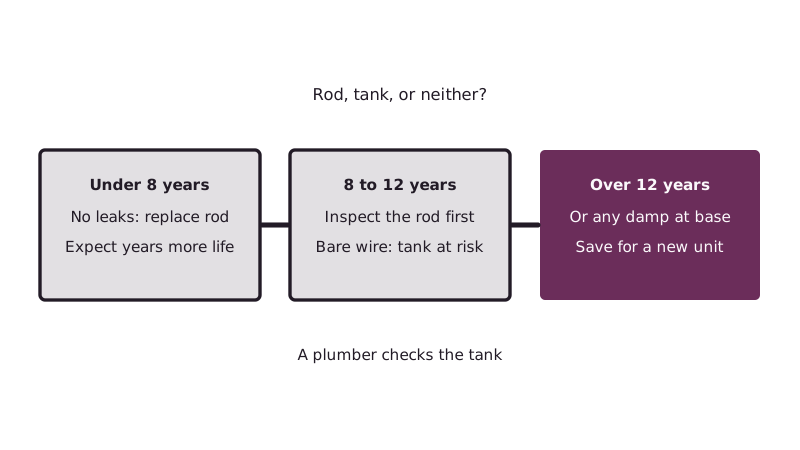
Quick decision aid:
- Under eight years, no leaks: replace the rod, expect years of added life.
- Eight to twelve years: inspect first. If the rod is mostly intact, change it; if it is a bare wire, the tank may already be paying the price.
- Past twelve, or any dampness at the base: save the money for a new unit.
When a new tank is the answer, local figures sit under replacement tank pricing, and how often heaters need replacing covers the timeline. Tankless units have no anode rod at all, which is one of the points in tank versus tankless.
Can I do it myself?
Possibly, for a handy owner with a long breaker bar, a socket that fits the rod head (often 1-1/16 inch, so check) and a tank drained down a few gallons. Order of work: shut off electricity or gas, close the cold inlet, drain some water, unthread the old rod, then tape the new rod's threads and fit it. Breaking the old rod loose is the hard bit, and a seized one means calling a plumber.
Safety comes first. On an electric unit, open the breaker and confirm it is dead; on gas, set the control knob to off. A heater that already leaks is off limits. The state contractor rule starts at $1,000 or any permitted work, and a plain rod swap stays under it. Water weeping at the port afterward means closing the inlet and phoning for help.
Common questions
Can I tell the rod is spent without pulling it?
Not without pulling it out. Hints of wear include rusty-tinged hot water, a sulfur odor from the hot tap only, or a tank four or five years in with no check. Only inspection proves it: a skinny core wire with most of the metal gone means the rod is spent.
Is a powered anode rod worth it?
It runs on a small current rather than being consumed, so it can last far longer, but it costs more and needs a power connection. Many plumbers see it as most useful in very corrosive water or where access is tight. For most Anaheim homes a standard magnesium or aluminum rod is the common choice.
Could a stinky hot tap mean the rod is at fault?
A sulfur odor from the hot side alone is often tied to bacteria reacting with a magnesium rod. A plumber might propose an aluminum-zinc rod or a disinfecting flush. The smell does not prove the rod is guilty, so describe it when the plumber arrives.
Will a new rod lengthen the heater warranty?
Not by itself. Warranty terms depend on the manufacturer and the model, and some require service by a qualified person. Check the manual or warranty card for your unit before touching anything yourself. Other tank questions are collected on the main Citrus Belt Plumbing page.
Sources
Last updated