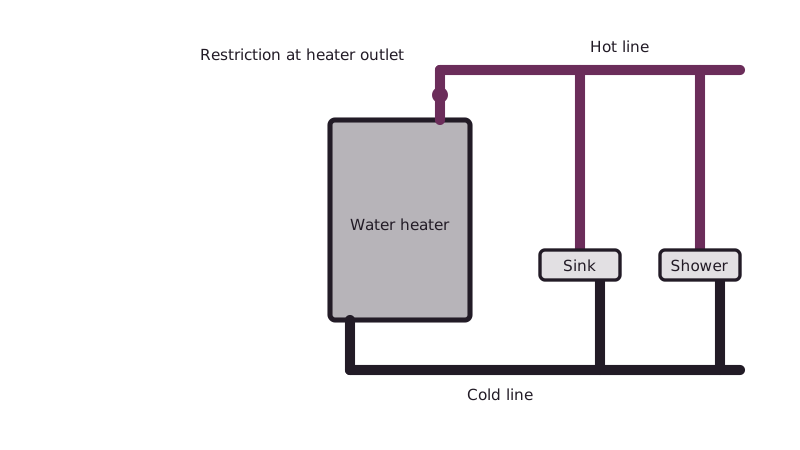
Run the cold tap, then the hot one, at the same sink. If cold gushes and hot trickles, the restriction is on the hot branch: the heater, the valves around it, or the pipe leaving it. If both are weak, the trouble is upstream and belongs to a different checklist, why water pressure drops. For hot-only trouble, start with the heater itself on the water heater page, then work through the five checks below.
Why is my hot water weaker than my cold water?
Something on the hot side is narrowing the flow. Candidates include scale choking the heater or its outlet, a heater valve left part-closed, rusting steel pipe on the hot line, a worn shower cartridge, or a plugged aerator. Cold water skips all of those, which is why the two differ.
In Anaheim the first suspect is scale. The city's water runs near 18 grains per gallon of hardness, and heating water drops that mineral out as chalk. Inside a tank it falls out as sediment. On pipe walls it forms a crust that shrinks the opening, and a tankless unit gets a coating on its heat exchanger.
The pattern tells you a lot. One fixture weak on hot: a local part. All hot taps weak: the heater or the main hot line.
Which fixtures are affected?
Test at a minimum of three places, a bathroom sink, the kitchen and a shower, hot first, then cold. Hot weakness at the shower and nowhere else implicates its cartridge or head. If the kitchen is weak but the bathrooms are fine, look at that sink's stop valve and aerator. Several fixtures weak together point toward the heater.
Unscrew the aerator at the spout and rinse it. Gray grit or white flakes confirm scale. Let a showerhead soak in vinegar through lunch, then retest.
Our pages on weak shower pressure and on the pressure regulator cover the parts of the system that affect both hot and cold.
What can I check at the water heater itself?
Look at the two shutoff valves on top. The cold inlet and the hot outlet should both be fully open, with the handle parallel to the pipe. After a repair, a valve is sometimes left partly shut, which is a classic cause. Next, feel the pipes: a hot outlet that is barely warm while the tank is hot hints at a restriction right at the tank.
A gas model comes with one hard rule. If there is any odor of gas, everyone exits without touching a switch or the control dial. SoCalGas takes gas emergencies at 1-800-427-2200, so ring from the driveway rather than from inside. Anyone feeling unwell should get 911 first. The burner compartment stays closed. On an electric model, switch off the breaker before opening any panel.
If the valves are open and the pipes feel normal, sediment inside the tank may be choking the outlet. A tank that thumps or crackles while heating is hinting at a layer of sediment below.
Could the tank or a tankless unit need flushing?
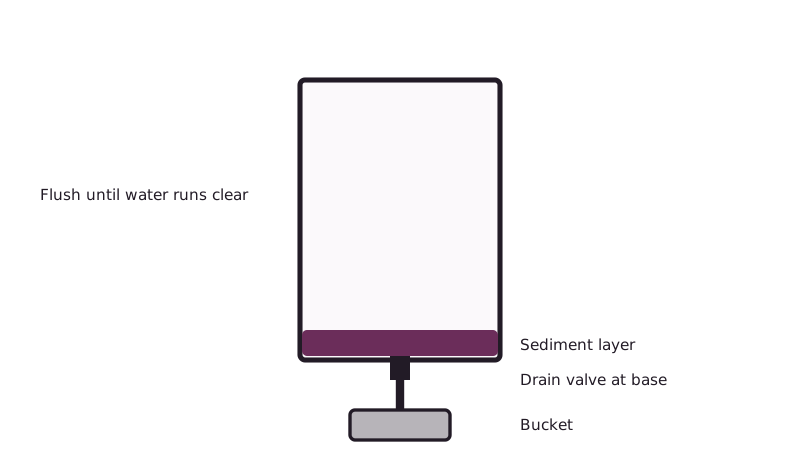
Often, yes. Opening the drain valve at the base and letting a few gallons run into a bucket carries sediment out. Heavy buildup can take several flushes. Old tanks with years of scale may not drain cleanly, and a stuck drain valve can leak once opened, so stop if it will not close again.
Tankless heaters need descaling instead. California's energy code asks for isolation valves with flushing fittings on the cold and hot pipes of larger tankless units, which lets a plumber circulate descaling solution through the heat exchanger. Ask whether yours has them. The page on a tankless unit with no hot water shows the related symptoms.
Hard water will bring the scale back. Over a year or two, a softener or scale control pays for itself in fewer repairs, and preventing hard water scale explains the options.
When is the pipe itself the problem?
Where the supply lines are galvanized steel, rust builds from within, and the hot side, which scales faster, can shrink to a sliver of its original width. Rusty water, flow that has faded over years and a pipe that feels rough inside point this way. The fix is replacing the line, not cleaning it.
Copper hot lines can also scale, and a pinhole leak somewhere along the run can lower pressure at the end. Check for damp spots on the ceiling or wall near the route.
An aging heater may as well be replaced, which removes the restriction in one move. Swaps go through a plumbing permit at the city Building Division, and water heaters must be strapped and fitted with a relief valve and drain. A plumber handles the permit.
At what point does this need a professional?
Book one if valves are open and aerators clean yet hot stays weak, if the tank refuses to drain, if you spot rust or damp, or if the heater is aging. Tell us what the taps are doing through the quote page, and a local plumber gets lined up to look. Browse everything else we arrange from the Citrus Belt home page.
Common questions
Can low hot water pressure damage the heater?
Weak flow itself does not harm the unit, but the cause might. Scale that restricts flow also makes the heater work harder, since the element or burner has to push heat through a crust. A tank full of sediment can overheat the bottom and shorten its life. Treat persistent low hot pressure as a warning to inspect.
Does hot water pressure drop in winter?
Not from the weather in Anaheim, where winters are mild. Colder incoming water makes the heater work longer, but it does not reduce pressure. A winter change more often means a valve was bumped or sediment finally reached the outlet. Check the heater valves and aerators first.
Is a pressure regulator involved?
Only if both hot and cold are affected. A regulator reduces the pressure for the entire house, so a failed one weakens every tap. If the weakness is on hot only, look at the heater side first. A pressure gauge on the front-yard bib shows whether the supply to the house reads normally.
Sources
Last updated