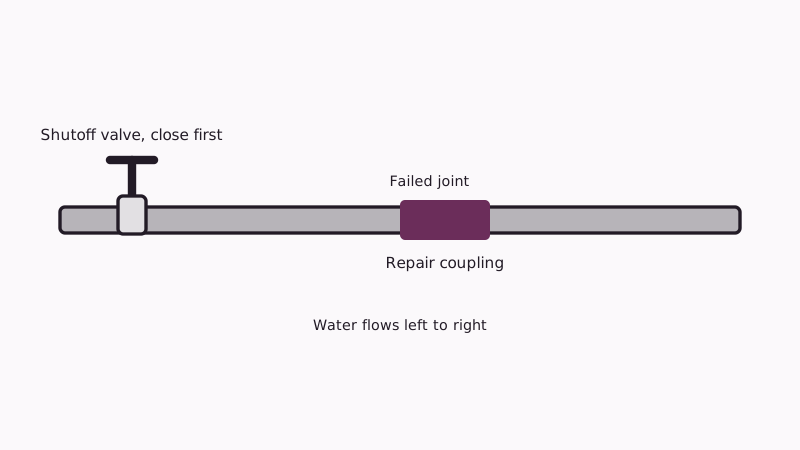
Cut the supply to the leaking stretch first, let the pipe run empty, wipe it dry, then choose between a patch and a replacement piece. In plastic pipe the cause is nearly always a joint, a crimp ring or a crack from sun or pressure, and a clamp holds it until the part is swapped. If the pipe is buried or inside a wall, leave it to a plumber: we explain on the home page how a local plumber reaches an Anaheim address.
Which valve do you close first when plastic pipe leaks?
Close the nearest stop valve upstream of the leak, and if you cannot find one, use the main shutoff at the house. Leave the lowest faucet running and the pipes drain themselves. A pipe that is still under pressure cannot be dried, and nothing you wrap around it will seal until it is.
Sinks and toilets carry their own little stop valves, which is enough for a fixture line. A leak partway along a run needs the main. Check by the front spigot, or on the garage wall. A stuck handle means you should pause and ask someone through the quote page, not to reach for a bigger wrench.
How do you tell PVC, CPVC and PEX apart?
Look at the color and the wall. White or cream, rigid, glued joints inside a house usually means CPVC, which is rated for hot water. Grey rigid pipe is typically PVC, used for cold lines and drains. Soft, bendable tubing in red, blue or white with ring fittings is PEX. The repair differs for each.
Printed lettering along the pipe names the material and size. Write it down before shopping. Polybutylene, a grey or blue flexible pipe found in some homes from the 1970s to mid 1990s, is a different story: it is no longer used, and a leak there is a reason to read about polybutylene pipe replacement rather than patch.
How do you stop a plastic pipe leak for a few hours?
Dry the pipe, then clamp a rubber-lined repair sleeve over the leak, or stretch self-fusing silicone tape around it, each turn covering half of the last. Epoxy putty works on pinholes but suppliers disagree about plastic, so expect it to last days, not months. Whatever you use, plan to cut out the damaged part afterward.
A repair clamp has to match the outside diameter of the pipe, which is why the printed size matters. Tighten it evenly, then turn the water back on slowly and watch for a minute. If it weeps, drain the line and start again. Do not wrap tape over a wet pipe and hope.
How do you fix it permanently?
Remove the damaged stretch with a clean right-angle cut, smooth the burrs, then bridge the gap with a fitting made for that pipe. With PEX you can use a push-fit sleeve, or cut and crimp a new ring. For PVC or CPVC, use a repair slip coupling and primer and cement made for that plastic, or a push-fit sleeve that lists that plastic on its label. Check the label before you buy.
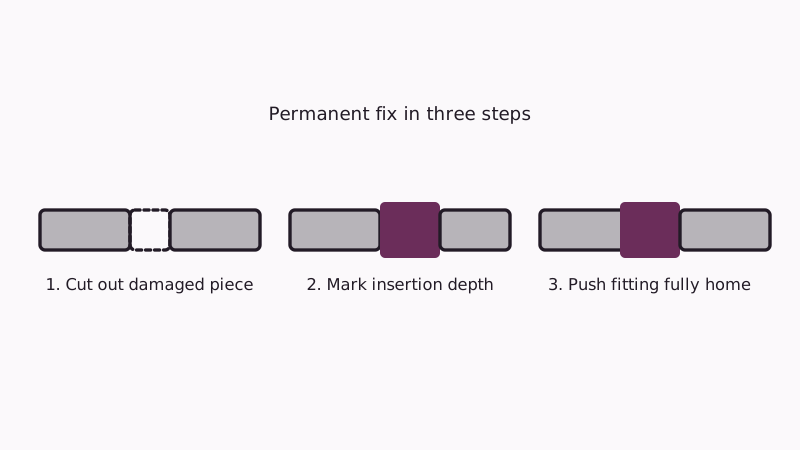
A few rules save a second leak:
- Cut square, because a slanted cut will not seat in a push-fit fitting.
- Pencil a line where the pipe must stop inside the fitting.
- Prime and cement solvent joints, then hold for the time on the can.
- Let cement cure before the pressure comes back, as the label says.
Jobs where the pipe is behind drywall, under a slab or part of a repipe are not casual DIY. A house repipe or a hidden leak calls for a plumber, and a permit may apply. California has two triggers. One is price: $1,000 with parts included. The other is a permit. Hit either and the plumber must hold a contractor license.
What about a leaking plastic pipe outside?
Outdoor plastic fails for different reasons: sunlight makes PVC brittle, lawn equipment strikes it, roots and shifting soil pull on joints, and sprinkler valves surge. Shut off the irrigation zone or the hose line, cut out the cracked piece and fit a coupling. Cover exposed plastic with paint or insulation so it survives the next summer.
Anaheim summers are hot enough that bare PVC along a side yard wall can go chalky and crack within a few seasons. Irrigation lines are cheap to fix. Soggy turf between the meter and the front door is a bigger worry, since that line is buried and finding the break takes electronic listening gear. Start with the leak detection cost guide.
And a dripping kitchen or bathroom faucet?
Turn the little stop valve under the basin, pull the handle, and inspect the washer, cartridge and O-ring inside. The part that wears out is usually cheap. Water around the spout base points at an O-ring. A drip from the spout tip points at the cartridge or the seat.
EPA reports that a tap dripping once per second wastes upwards of 3,000 gallons annually, which is why a slow drip is worth fixing. The leaky faucet repair page covers each type. Supply lines under the sink that are PEX or braided flexible are another common leak point, usually at the nut, and snugging that nut a little is sometimes all it needs.
How do you keep pipes from splitting in the first place?
Keep water pressure in the normal range, protect exposed pipe from sun and cold, and replace brittle or old parts before they fail. High pressure is the quiet killer of plastic fittings. Code generally asks for a regulator when street pressure tops 80 psi. Thread a gauge onto the outdoor spigot and read where yours sits.
If the regulator has drifted, see water pressure regulator replacement page. Other habits help. Do not let freezing air sit on an exposed run in the foothill neighborhoods, insulate where pipe crosses a cold crawlspace, and close the main before a week away. Why they fail is in what causes a pipe to burst.
How do you choose a reliable plumber and avoid being ripped off?
Search the contractor on the licensing board website first, and ask for a price on paper. On deposits, California lets a contractor ask for the lower of $1,000 and a tenth of the price. Beyond that, walk away. That is the California limit for home improvement contracts. Also ask what the fitting is and where the old part went.
Good signs: the plumber explains the failure and shows the damaged piece, quotes a range by phone, and arrives with parts for the material in your house. Bad signs: a quote that changes, cash only, pressure to replace everything when one joint failed. Swapping a single fitting should cost a sliver of what a repipe does, so ask why if the number jumps.
How much water does a leak waste?
The EPA figure for an average household is above 9,300 gallons lost to leaks each year. Hunting a hidden leak is simple: note the meter, keep every tap and appliance idle for two hours, then compare. If the dial has crept forward, water is leaking somewhere, whatever the pipe is made of.
Common questions
How do I make my own pipe clamp?
A homemade clamp is a stopgap: fold a piece of rubber from an old inner tube around the split and tighten two stainless hose clamps over it. It can hold for a few hours at modest pressure. Replace it with a proper repair sleeve or a new coupling as soon as you can, and do not leave it behind a wall.
Can I use epoxy or tape on a plastic pipe?
Silicone tape that fuses to itself suits small leaks on a straight, dry stretch. Epoxy putty can seal a pinhole, though sources disagree on how well it bonds to plastic. Both are temporary. The lasting repair is to cut out the section and install a new fitting, or replace the pipe.
Is a push-fit coupling a permanent repair?
On PEX, CPVC and copper, push-fit couplings are widely used for permanent repairs when installed correctly and allowed by local code. They need a clean square cut and full insertion. Read the product label, and ask your city's Building Division when the job goes beyond a simple repair.
When should you stop and hand it over?
Hand it over if the pipe is buried in the wall, ceiling or concrete, when a mended leak returns, when stains keep spreading, or when several joints weep together, which hints at high pressure or aging pipe. The plumber can check pressure and find the cause instead of just stopping one drip.
How long can a temporary fix last?
Hours to a few days for tape and putty, a little longer for a good clamp on a low-pressure line. None of them is meant to stay. Treat the patch as the time you need to buy parts or get an appointment, and check the spot for damp every day.
Sources
Last updated