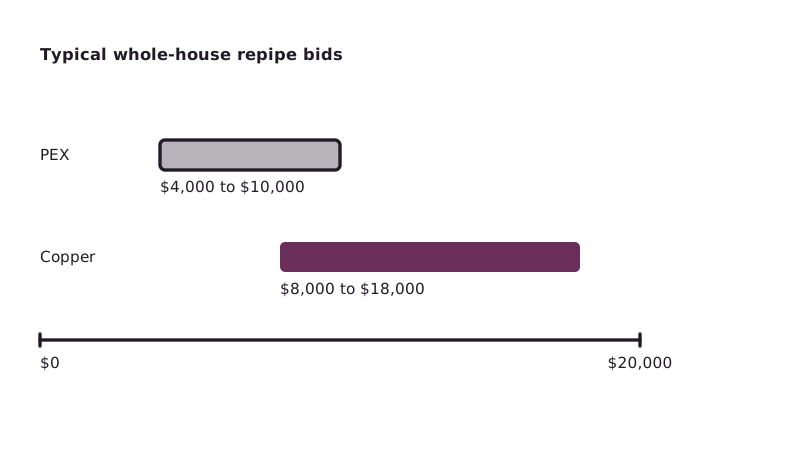
Ordinary single-family houses around Anaheim see PEX repipe quotes of roughly four to ten thousand dollars, copper bids of eight to eighteen thousand, and one Southern California guide spreading both across $4,500 to $18,000. Sources disagree, so read these as orientation. The whole job is walked through on the repipe house page.
Where do PEX repipe bids usually land?
Guides covering Southern California put whole-house PEX at roughly $4,000 up to $10,000. Statewide sources differ: one shows $3,000 to $8,000, another averages $6,000 to $15,000 for California. A mid-sized home in San Jose was cited at $8,000 to $10,000, with permits near $1,000 on top. Size, fixture count, access and patching explain the spreads.
Plumbing businesses wrote many of those pages, and the ranges overlap awkwardly, so the safest reading is a band: bottom of the range for a compact house that is easy to reach, top of it for a large one behind finished walls. A two-bathroom house falls inside it, nearer the lower-middle when access is simple. Only a written quote for your address gives a real figure.
What is inside the number?
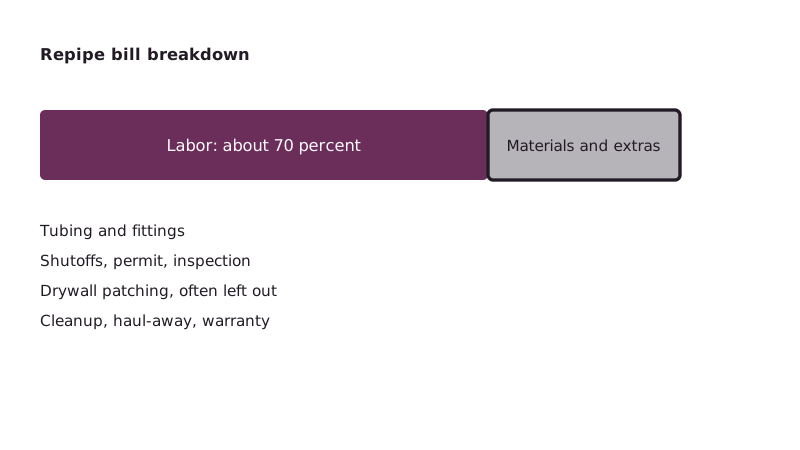
Most of it is labor. Cost guides attribute about 70 percent of a repipe bill to labor, with the rest covering tubing, fittings, a new manifold if used, shutoff valves, permit and inspection, and wall repair if included. That is why the same tubing can produce a $4,000 quote on one house and $10,000 on another.
Items to look for on a line-item bid:
- Tubing and fittings for every fixture, hose bib and appliance
- Main shutoff and pressure regulator work, if included
- Water heater connections
- Permit and inspection fees
- Drywall patching, texture and paint, or a statement that these are excluded
- Cleanup and haul-away
- Warranty terms in writing
Wall repair is the item most often left out. Ask directly, because a quote that excludes it can be thousands cheaper on paper and thousands more later.
How much more does copper cost than PEX?
Guides describe copper as running 40 to 60 percent above PEX. Long Beach pricing pairs PEX at four to ten thousand dollars with copper at eight to eighteen thousand; a Bay Area source lists PEX at $6,500 to $12,500 against copper at $9,500 to $18,500. Copper itself is pricier, and sweating joints takes longer than making PEX connections; together those explain most of the difference.
In the San Jose example the same guide shows copper around $9,000 to $11,000 beside $8,000 to $10,000 for PEX, a tighter spread than the general rule. Our PEX versus copper comparison goes through life span and performance. Copper has a long record and tolerates heat; PEX is faster to install and cheaper. Anaheim's own hardness data, about 15 to 19 grains in published figures, is worth mentioning to any bidder, since water chemistry affects how each material ages.
Does a flow-rate chart change which one to pick?
Not usually. Pipe of one nominal size can carry slightly different inner diameters, and PEX fittings may restrict flow somewhat, which is why plumbers sometimes go up a size or choose a manifold layout. For a house with modest demand, the difference is small, and either material meets code. Ask the bidder how they sized the lines and how many bathrooms the design supports.
We are not printing a flow chart here, because the numbers depend on the manufacturer and tube type and we could not verify one from a neutral source. If flow matters because of a large house or many fixtures, ask each bidder to explain the sizing. The comparison of PEX A and PEX B covers the tubing types themselves.
What about swapping out polybutylene or galvanized lines?
Taking out polybutylene is a repipe, so the same bands apply, with a typical PEX job near the middle of the range quoted earlier. The reason is the material's record: gray or blue plastic put in between about 1978 and 1995 can fail through chlorine attack and cracking fittings. Galvanized steel earns a full repipe as well once corrosion is widespread.
If your house was built in that era, look at the main shutoff and under sinks to identify the pipe. More background is in polybutylene pipe replacement and galvanized pipe replacement. Both pages cover the signs and the decision, and this page sticks to prices.
What about a mobile home repipe?
No dependable published prices for manufactured homes turned up, and a made-up figure would help nobody. Smaller footprints can mean less labor, though access beneath the floor or inside the walls differs, and parks often set their own rules. Have the plumber price it after a walkthrough and put the access method in writing.
The same drivers hold for smaller homes: fixture count, access and scope. Check whether skirting or underbelly repair is covered, since it is often separate. Park management may need to sign off too, so speak to them before a date is set.
Which extras tend to inflate the final bill?
Permits, inspections and patching. Guides list repipe permit fees from about $200 to well past $1,000 depending on the city, with inspections both before walls close and at the end. Stucco, tile and plaster make restoration costlier. A contractor license covers permitted work in California, and state rules cap a down payment at 10 percent or $1,000, whichever is less.
Time is a cost too: most repipes run about three to four days start to finish, with the supply cut for stretches of each day. Anaheim's published guidance says a property owner or a contractor can pull the plumbing permit, which is one more reason to ask who files it. For the wider breakdown, open repiping totals by house type.
Common questions
What would a house with two bathrooms run?
None of the guides we read isolates a two-bathroom figure, but such a house sits inside the general PEX band. Where exactly depends on fixtures, stories and wall access. Request an itemized quote that counts each fixture, since that is how plumbers build the price.
Is PEX cheaper than copper in the long run?
At purchase, yes, by about 40 to 60 percent per cost guides. Over decades the answer hinges on water chemistry, workmanship and how long you stay. Copper boasts the longer record, while PEX needs fewer joints and does not corrode the same way. Neither wins for every house.
Will a repipe change my water pressure?
It can, when old galvanized or corroded pipe was choking flow. Pressure itself comes from the utility supply and any regulator, so new pipe cannot lift it past that. If it is already high, the plumber may propose checking the regulator at the same visit.
Can I finance or phase the work?
Some contractors offer payment plans, and some homeowners phase the job by section, though doing a repipe in pieces usually costs more overall. Ask for both a full and a phased price. The Citrus Belt Plumbing home page shows how a visit gets arranged.
Sources
- City of Anaheim Building Division, when a permit is required
- California Contractors State License Board, what kind of contractor you need
- City of Anaheim Water Hardness
- Published whole-house repipe prices from California and Southern California plumbing businesses and cost guides, checked November 2026
Last updated