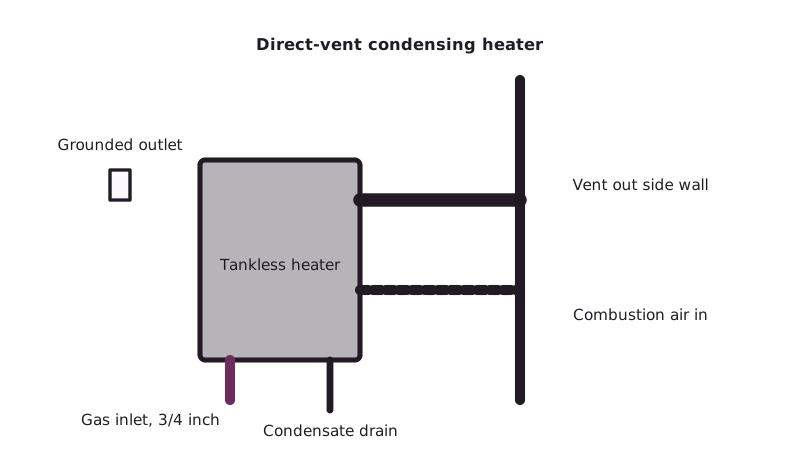
Navien's NPE line is a condensing, direct-vent tankless heater, which means it extracts extra heat from exhaust gas and vents through plastic pipe instead of a metal flue. That design is why installs differ from a basic tank swap. The numbers below come from Navien's published specifications for the NPE-210S2, so your model's manual always governs. For the repair-or-replace decision, start at water heater repair and replacement; this page is about the Navien install itself.
What makes a Navien installation different from a tank swap?
Three things: gas demand, the vent and the condensate. Navien rates the NPE-210S2 at 12,000 to 180,000 BTU an hour, several times the draw of an ordinary tank burner, so the gas pipe has to carry more. Exhaust leaves through narrow plastic pipe, and the condensing process leaves acidic water that needs a drain. Isolation valves on the water side make later flushing possible.
In practice a plumber confirms four things before ordering the unit:
- Gas pipe size and length from the meter to the heater.
- Vent route to an exterior wall or roof, and its length and number of elbows.
- Condensate drain location: a floor drain, laundry standpipe or sink trap nearby.
- A grounded outlet nearby, because a fan and a control board run on house current.
In plenty of older Anaheim and Fullerton houses the heater sits in a garage nook or cramped closet. Shifting it a few feet to reach an outside wall for the vent can change the quote.
How big does the gas line need to be?
The NPE-210S2 has a 3/4 inch gas inlet. Navien allows 1/2 inch pipe only on runs of about 24 feet or less, always subject to local code and National Fuel Gas Code sizing. Longer runs, or other appliances sharing the line, need larger pipe. The manual carries sizing tables; undersize the line and the burner goes hungry at full demand.
Specifics from the older NPE manual: the unit wants at least 3.5 inches of water column of inlet gas pressure, flexible gas connectors must not be crimped or bent tightly, and an excess flow valve that is too small can cause poor operation. A plumber measures pressure while the unit fires, not only when it idles.
Gas work is regulated, so the pipe changes go to a contractor and typically involve a permit and inspection through the city's Building Division. The gas side gets more room in gas tankless water heater installation, and the flexible gas line page explains why diameter and length matter.
How is a Navien vented?
Direct venting means the unit pulls its combustion air from outside and a fan pushes exhaust out through 2 inch or 3 inch pipe. Navien lists PVC, CPVC, approved polypropylene and stainless steel. Its feature list gives 75 feet for 2 inch venting, while its FAQ says 60 feet with up to six elbows, so confirm the limit in your manual before planning a run.
Condensing exhaust runs cooler than a metal flue, so the pipe can usually exit through a side wall, handy for garages and closets. The manual lists clearances from windows, doors and other openings, and vent runs are normally pitched so condensate drains back toward the unit. The city inspector checks these points.
Where does the condensate go?
By pulling extra heat from its exhaust, a condensing heater produces mildly acidic water. It needs an exit: a pitched line to a floor drain, a laundry standpipe, a sink tailpiece or a small pump. A neutralizing cartridge is required in some places and by some manufacturers, so ask the plumber whether the city wants one with the model you choose.
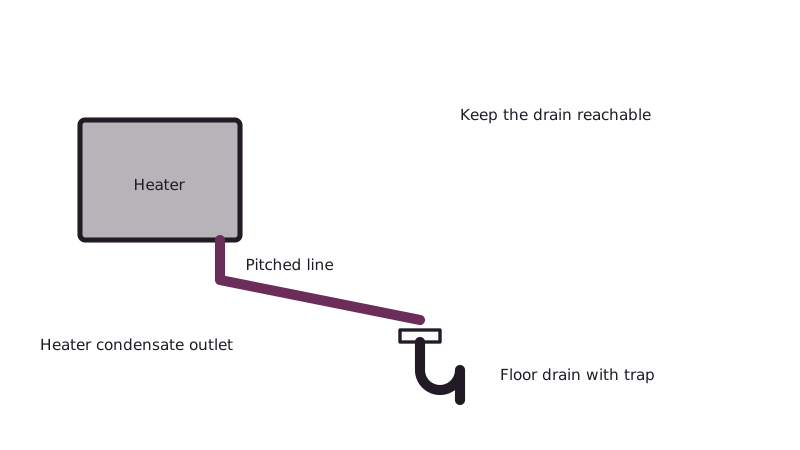
Keep the drain reachable. Condensate lines clog, and a blocked trap can stop the heater with an error code. If it shuts down with a drain message, the manual's troubleshooting section names the code for your model, and troubleshooting a tankless heater that runs cold lists the first checks.
What should I know about water flow and recirculation?
The unit starts heating at 0.5 gallons a minute, Navien says, and tops out at 10.1 gallons a minute when it only has to raise the temperature 35 degrees, dropping to 5.3 at a 67 degree rise. Colder incoming water or a hotter setpoint shrinks what it can deliver, so several fixtures at once may call for a larger model. The Department of Energy describes tankless output as roughly 2-5 gallons a minute in general.
Navien's ComfortFlow, a buffer tank plus pump, shortens the wait and softens the cold water sandwich. Per Navien it applies to NPE-A2 models, not the NPE-210S2, and recirculation raises energy use. Mention it if one bathroom is a long pipe run from the heater. A recirculation pump is the usual remedy when hot water arrives late; see installing a recirculation pump.
Is Anaheim's hard water a problem for this heater?
Yes, it is the chief long-term risk. Anaheim's utility lists hardness near 18 grains per gallon, and the resulting crust on the heat exchanger lowers efficiency and can trip error codes. Insist on service valves so the heater can be flushed, set a descaling routine, and consider a softener to protect the rest of the house too.
Navien's own FAQ also notes a no-hot-water, no-code fault is often a flow sensor that is not turning, and says cycling the pressure relief valve may help temporarily. Beyond that, call the installer or a service specialist. Warranty terms matter here: Navien lists, for residential use, 1 year of labor, 5 years on parts and 15 years on the heat exchanger, with shorter terms for recirculation set-ups that run uncontrolled. Read your registration terms, and keep proof of a professional installation.
What belongs on the quote for a Navien job?
Spell out the exact model, gas pipe size and run length, vent material and route, how condensate will drain, and who handles the permit. Learn who registers the warranty and who services the unit afterward. Have the plumber add up the BTU demand of everything on that gas line, since a range, dryer and furnace may share one supply.
Pricing appears line by line in what a tankless install costs. To start a request, the quote page asks for the heater location, current fuel and bathroom count.
Common questions
Can it go where my tank heater sits now?
Sometimes. It hangs on a wall, so floor space is not the constraint; the gas line, vent route and drain are. A tank that vented up a metal flue gives way to plastic pipe headed for an outside wall, which takes work. The plumber checks clearances and code before agreeing to the same spot.
Is this one for a handy homeowner?
Not really. Gas connections, vent work and the permit belong to a contractor, and errors risk leaks or carbon monoxide. Warranty terms may also assume a qualified installer. Read the manual beforehand so your questions are sharp, then leave the connections to a professional.
Is it a same-day job?
Usually. Published guides put a tank-to-tankless conversion at four to eight hours, more if the gas line or vent needs fresh runs. Hot water is unavailable throughout. Before leaving, the installer should leak-test the gas joints and take the unit through a heating cycle.
Does it need an electrical outlet close by?
Yes, a condensing unit relies on house current for its fan and controls, so a grounded outlet should be within cord reach. Lacking one, an electrician may have to add it. Raise that with the plumber in advance rather than discovering it on the day.
Will it work during a power outage?
Generally no. Fan, ignition and controls all need electricity, so hot water stops when the power does. Some owners add a backup supply, but get the plumber's advice and the manual's approval first. If outage resilience matters to you, mention it before choosing between tank and tankless.
This guide is one of many on Citrus Belt Plumbing plumber.
Sources
Last updated