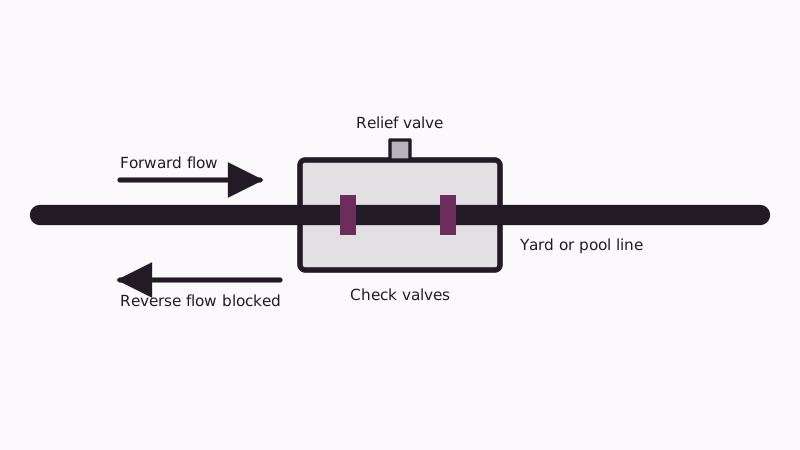
Backflow is water flowing the wrong way. When pressure drops in the street main, a hose left in a bucket, a sprinkler head sitting in a puddle or a boiler loop can suck used water backward into the lines serving the whole street. A backflow prevention assembly blocks that, and a worn one blocks nothing. Like the work on gas lines, this is plumbing where the rulebook, not the homeowner, decides who may do the work. Book through the quote page.
Does my house have a backflow assembly?
Many do not, and many do. Look at the irrigation system, the pool or spa fill line, a fire sprinkler feed and any second water source. Those are the usual reasons a utility requires one. The assembly itself is a bronze or stainless body with two shutoff handles and small test ports, often in a box beside the meter or near the sprinkler valves.
Simple hose-bib vacuum breakers, the small brass cap screwed on an outdoor spigot, are a different device. They are not part of the yearly assembly test. If a notice from the city or water district arrived in your mailbox, it came because the utility has a record of a testable assembly at your address.
When in doubt, take a photograph of what you see and ask the water provider whether the address has a device on file.
How often does it have to be tested?
Once a year, for as long as the assembly is in service. Anaheim states that backflow devices connected to its system must be tested annually, and that a device that needs repair must be fixed and tested again. The State Water Board's handbook, effective July 2024, also calls for at least annual field tests.
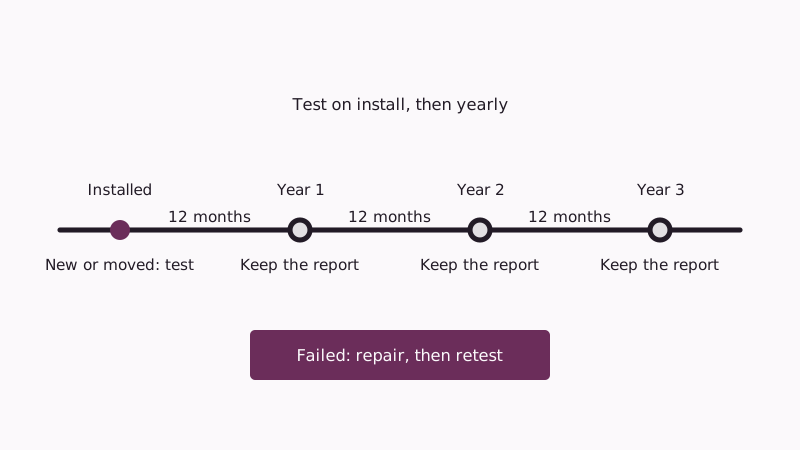
Your due date is the utility's call, often tied to the date of the last report. New assemblies are tested when installed, and an assembly that was moved, rebuilt or had its piping changed should be retested.
Each city or district runs its own program, so a house in Fullerton or Orange follows the notice from that provider. Keep the paperwork. A copy of every passing report belongs in the same folder as your other home records.
Who can perform the test legally?
Only a tester the utility accepts. In Anaheim that means sign-off from the Orange County Health Care Agency, a current city business license and a spot on the city's approved list. The state handbook asks for a recognized certification as well. A handyman with a gauge does not qualify.
Test results are submitted through an online system, because Anaheim no longer accepts reports by mail or email. Whoever runs the test should file it and hand you a copy. If you book through us, a local plumber attends, and we will confirm who files the report before the appointment.
The rules for larger properties are in commercial backflow testing, which has its own price notes.
What happens during the test?
With a gauge connected to the test ports, the tester closes the valves in a fixed order and observes whether the checks and the relief valve hold pressure. The whole sequence is short. Water to the house is off for a few minutes, so run your errands first. The tester records the readings and marks the assembly as pass or fail.
You can read the mechanics in how backflow testing is done. It is for understanding only, because a passing result counts only from an approved tester.
Make the assembly easy to reach: clear leaves and mulch from the box, unlock gates and keep dogs inside. If the box is full of water, say so when you book. A flooded vault slows the test and sometimes means a leak on the assembly itself.
How much does it cost?
Contractor price guides in California show about $75 to $200 for each annual device test, with residential assemblies at the lower end. Repairs on a failed home-size device are typically quoted from about $100 to $400, parts and labor together, while a full replacement costs more. Ask for the number written on the quote.
Prices rise when the box is buried, when the device is hard to reach or when a rebuild kit is needed. A visit to test several devices, such as irrigation plus a pool line, usually costs less per device.
Those ranges come from contractor price guides rather than from any city fee list. For more on how the total builds, see backflow assembly testing costs.
What is covered in a mobile home plumbing inspection?
A mobile home inspection checks the parts that can fail unseen: the supply pipe type and condition under the floor, the main shutoff, the heater plus its discharge line, drains and traps, the roof vents and the connection at the lot. A plumber looks for leaks, wet insulation, sagging drain lines and polybutylene, then writes what he or she found.
A buyer gets the most out of it before the offer is final. The report gives you repair costs to bargain over, and it tells you whether a repipe is likely soon. If the lot has a backflow assembly or an irrigation line, include it in the walkthrough and ask about the test record.
Freezing is not a big worry in Anaheim, but older homes still deserve a look at exposed pipe, as in the guide to winterizing mobile home plumbing. Pricing for a general inspection is in what a plumbing inspection costs.
What if the assembly fails?
The tester will tell you what failed. A leaking check or a dribbling relief valve can often be rebuilt on the spot using a kit, with a retest straight after. A corroded body, or one that is the wrong type for the hazard, may be cheaper to replace.
Do not ignore a failure. The utility expects a passing report by a set date, and its notice explains what follows if one is missing. Repairs and replacement may need a permit, so ask the plumber how it is handled in your city.
Common questions
Is the test a code requirement or just advice?
For a house with a testable assembly, it is a requirement of your water utility, based on state rules and the local ordinance. Anaheim cites the federal Safe Drinking Water Act amendments, state regulation and its municipal code. Skipping it can lead to notices and, in time, interrupted service.
Which kinds of assembly are there?
The common ones are the pressure vacuum breaker, often used for sprinklers, the double check assembly for lower hazards, and the reduced pressure assembly for high hazards. The utility decides which one your property needs. All of them are tested the same general way, with a gauge, and all need a passing report.
Can a homeowner run the test personally?
Not for a report the utility will accept. Only an approved tester's results count. Useful homework you can do: locate the device, keep the area clear, and file the paperwork. If you do tinker with valves, you may make a good device fail, or hurt the water quality for the street.
How long should I set aside?
One home assembly usually means a brief visit, commonly under an hour with setup and forms. Several devices or a hard-to-reach box add time. If a rebuild is needed, the plumber may complete it on the same trip with the right parts on the truck, or return the next day.
The rest of our guides start from plumber across Anaheim.
Sources
Last updated